Part 2
Book 4 — Lacerations (Ch 1-7)
Lacerations (nadryv) — the Russian word doesn’t translate cleanly. Literally: a tear or wound in flesh. Dostoevsky uses it to mean an emotional wound you inflict on yourself, deliberately, and keep ripping open. Pushing your own pain to the breaking point — not to heal, but because the intensity becomes addictive. You hurt yourself, display the wound, then dig deeper. Performative suffering that becomes real suffering. Pevear/Volokhonsky translate it as “Strains” — neither version fully captures it.
Ch 1 — “Father Ferapont”
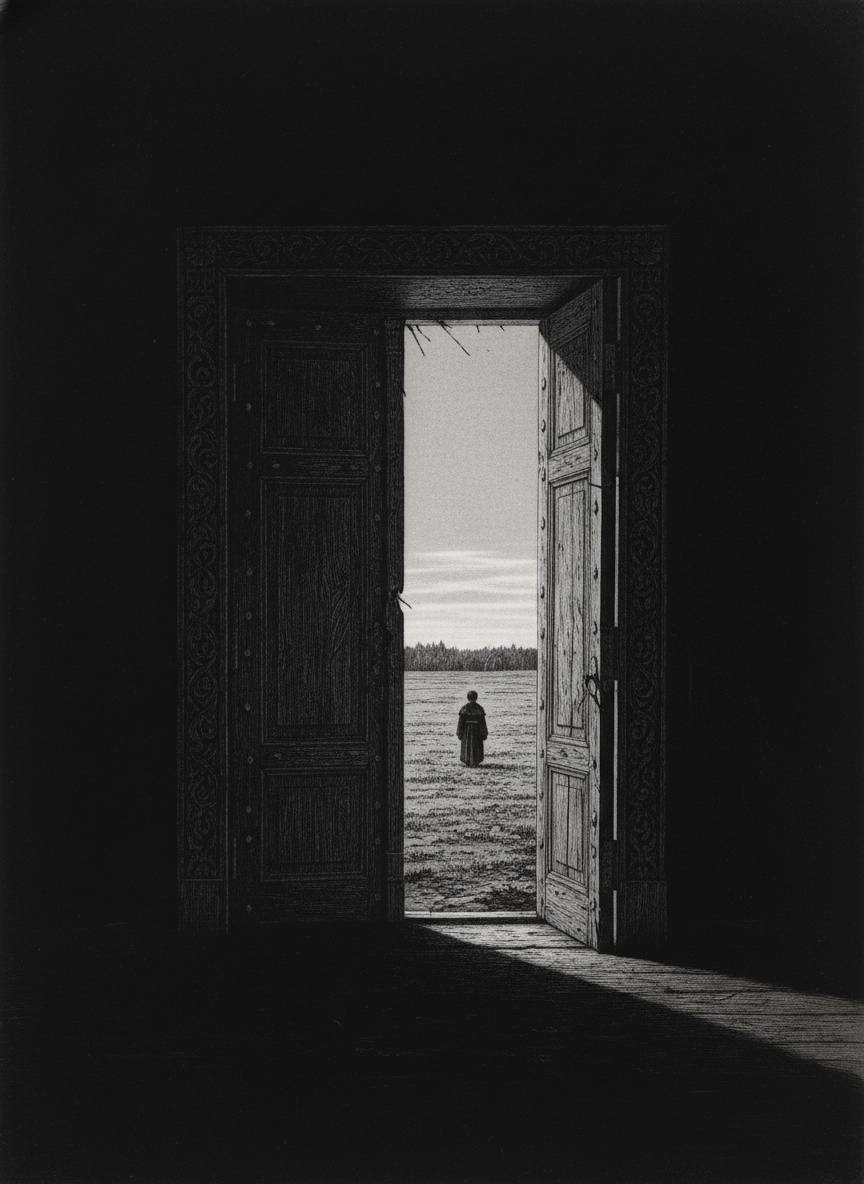
Zosima wakes before dawn knowing he won’t survive the day — but he’s joyful, not afraid. He takes confession, extreme unction, and delivers a farewell speech to the monks: love one another, monks aren’t holier than laypeople, every individual is responsible for everyone and everything on earth. Meanwhile, news of a “miracle” spreads — an old woman’s son returned exactly as Zosima predicted, and the monastery buzzes with excitement. Enter Father Ferapont, Zosima’s polar opposite: a seventy-five-year-old ascetic giant who eats two pounds of bread every three days, wears thirty-pound iron chains, and claims to see devils sitting on monks. A visiting monk from Obdorsk interviews him and gets an earful about devils in pockets, the Holy Spirit appearing as a blue tit, and Christ reaching through an elm tree at night. Zosima sends Alyosha away to fulfill his promises in town, promising to save his last words for him. Father Paisy delivers his own farewell — arming Alyosha’s mind with his best argument before sending him into the world: “And now, go, my orphan.”
What You Need to Know
Extreme unction (soborovaniye) — one of the seven Orthodox sacraments, performed for the seriously ill or dying. A priest anoints the body with holy oil while reading prayers and scripture. Receiving extreme unction along with confession and Communion together constitutes the full preparation for death in Orthodox tradition.
Prayer for the repose (za upokoy) — specifically a prayer for the dead in Orthodox tradition — funerals, memorial services. Praying za upokoy for a living person was considered spiritually dangerous in Orthodox folk belief: you’re declaring someone dead before God when they’re not. It crosses the line from faith into superstition. Same logic as why you wouldn’t write a living person’s name in a church memorial book — it’s treated as a curse, not a prayer.
Holy fool (yurodivy) vs. ascetic — Ferapont occupies a grey zone. A holy fool acts mad to expose worldly vanity (Lizaveta in Book 3 was one). An ascetic deliberately punishes the body to purify the soul. Ferapont is treated as both — some monks see a saint, others see a showman. The ambiguity is the point.
Iron chains (veriga) — a real ascetic practice in Russian Orthodoxy. Monks wore weighted iron chains under their clothes as a form of continuous bodily penance. Ferapont’s chains weigh thirty pounds. The practice was controversial — some saw it as genuine mortification, others as spiritual performance.
The Lenten fasting schedule — the chapter lists an extremely detailed monastery fasting rule. The key distinction: regular monks follow a strict but structured schedule (specific foods on specific days). Ferapont eats only two pounds of bread every three days — far beyond what any rule requires. His fasting is freelance extremism, not institutional discipline.
Laodicean Council (Canon 50) — a church council held in Laodicea in Phrygia Pacatiana (near modern Denizli, Turkey), dated somewhere between 343–381 AD. Bishops from across Asia Minor gathered to standardize church discipline — everything from clerical conduct to liturgical practices to fasting rules. Canon 50 specifically: “The fast must not be broken on the fifth day of the last week in Lent” — meaning Maundy Thursday (Holy Thursday). Breaking it “dishonors the whole season of Lent.”
Pentecost (Pyatidesyatnitsa) — a major Christian feast fifty days after Easter, celebrating the descent of the Holy Spirit onto the apostles (Acts 2). In Orthodox tradition it’s one of the twelve Great Feasts — a full liturgical celebration with special prayers, hymns, and the decoration of churches with greenery and flowers. The day also marks the “birthday of the Church” — the moment the apostles received the power to go out and preach. In Russian peasant culture, Pentecost blended with older folk traditions tied to the start of summer.
“The Holy Spirit” vs. “the Holy Ghost” — Ferapont makes a distinction that doesn’t exist in Orthodox theology. In Russian, Svyatoy Dukh covers both. His separation of them into two entities — one appearing as a dove, the other as a blue tit — is either mystical insight or theological confusion. The monk from Obdorsk can’t tell which, and neither can the reader.
“In the spirit and power of Elias” — Elias is the Greek/Latin form of Elijah, one of the most important prophets in the Old Testament. He challenged the priests of Baal on Mount Carmel, called down fire from heaven, and — crucially — never died. God took him up alive in a whirlwind with a chariot of fire (2 Kings 2:11). That makes him almost unique in scripture. The phrase “in the spirit and power of Elias” comes from Luke 1:17, where it describes John the Baptist carrying Elijah’s mantle. Ferapont believes Christ will physically seize him and carry him away the same way — rapture, not death.
Ferapont’s northern dialect (okanye) — the text notes he speaks “with a strong emphasis on the letter o.” This is okanye, the signature feature of northern Russian dialects — the regions around Arkhangelsk, Vologda, and the White Sea coast, stretching toward the Arctic. Vast forests, isolated villages, deeply traditional communities that kept old ways long after Moscow modernized. Standard Russian (and Moscow speech) reduces unstressed “o” to an “ah” sound (akanye), but northerners pronounce every “o” fully. It marks Ferapont as provincial, rural, old-school — the opposite of educated monastery speech. Katz flags it in a footnote: “A characteristic of the dialect spoken in the north of Russia.”
“The gates of hell shall not prevail” — Matthew 16:18. Christ’s promise that the church will survive all attacks. Father Paisy uses it to argue that nineteen centuries of intellectual assault haven’t destroyed Christianity — the whole still stands even as scholars dismember the parts.
Obdorsk — a remote town in northwestern Siberia (now called Salekhard), near the Arctic Circle. A monastery there would be the farthest possible fringe of Russian Orthodoxy — cold, isolated, cut off. The visiting monk is a provincial outsider, easily impressed.
Margin Notes
Two kinds of holiness — Zosima and Ferapont exist in the same monastery but represent opposite visions of faith. Zosima: love, humility, joy even while dying, connection to people. Ferapont: punishment, isolation, seeing devils on other monks, fasting beyond any rule. The monastery contains both and cannot tell which is the real thing. Neither can the reader.
“Go, my orphan” — Paisy calls Alyosha an orphan before Zosima has died. He’s grieving forward. He arms Alyosha’s mind with an argument because he knows the world will come for his faith. The word orphan does double duty: losing his spiritual father now, never really had his actual one. Zosima passed the duty to Paisy — the handoff happens so naturally that Alyosha only realizes it afterward.
Highlights
"I may not live through this day"
He spoke of many things; it seemed that he wanted to say everything, to repeat it all before the time of his death, everything that he hadn’t finished saying during his life, and not merely for the sake of instructing them, but as if yearning to share his joy and ecstasy with everyone and all things, to pour out once again in his life everything that was in his heart …
Zosima’s farewell — not clinging to life, but trying to empty himself of every unsaid word before it’s too late.
Ferapont on devils in the monastery
“I saw a devil sitting on one monk’s chest, hiding under his cassock, only his horns sticking out; another had a devil with shifty eyes poking out of his pocket; and I was afraid; a devil had taken up in one man’s belly, in the dirtiest part; another had a devil hanging around his neck, unbeknownst to him, and he was carrying it around.”
Either terrifying spiritual sight or complete delusion — Dostoevsky won’t tell you which.
Ferapont on bread and the devil
“I can give up bread, not needing it all, and go into the forest and there live on mushrooms or berries; but these monks can’t live without their bread, therefore they’re bound to the devil.”
Ferapont’s theology in one line: need is weakness, weakness is the devil’s foothold.
Zosima's last words to Alyosha
“You should know that I won’t die before saying my last words in your presence. I’ll say that word to you, my son; I’ll dedicate it to you. To you, my dear son, because you love me. Meanwhile, go to those whom you promised.”
A spiritual inheritance promised — Zosima is holding on specifically for Alyosha.
Father Paisy's farewell
“Remember, young man, perpetually,” began Father Paisy directly, without any preface, “that secular learning, which has become a great power, has, especially in the last century, analyzed everything divine that was left to us in the Holy Books; and, after cruel analysis by the learned of this world, absolutely nothing is left of all that was sacred. However, they analyzed only in parts, and overlooked the whole; indeed, their blindness is reason to ponder. While the whole still stands before their eyes as steadfastly as before, the gates of hell shall not prevail against it. Hasn’t it survived for nineteen centuries? Isn’t it alive even now in the movements of individual souls and of masses of the common people? It lives steadfastly even in the movements of the souls of those utterly destructive atheists! For even those who reject Christianity and who rebel against it, in essence they still share the same Christian character, and such they have remained, because up to now neither their wisdom nor the ardor of their hearts was able to create a higher image of man and his dignity than the ideal demonstrated in days of old by Christ. Whatever were their attempts, the result was only abominations. Remember this especially, young man, since you’re being sent out into the world by your departing elder. Perhaps, recalling this great day, you won’t forget my words either, uttered from my heart to guide you, for you’re young and the temptations of this world are great and beyond your strength to bear. And now, go, my orphan.”
Paisy arms Alyosha with his best argument before sending him into the world — they dismantled the parts but the whole still stands.
The narrator on Paisy
The unexpected and erudite reasoning he had just heard, precisely that and not some other, bore witness to Father Paisy’s warm heart: he was hastening to arm the young man’s mind for the struggle against temptations, and to protect the young soul willed to him with the strongest defense he could imagine.
The narrator tells you directly — this was love disguised as a lecture.
Ch 2 — “At His Father’s”
Alyosha visits Fyodor the morning after Dmitri’s beating. The old man is alone — bruised, wrapped in a red kerchief, checking his reflection for the fortieth time. He rants about all three sons: Ivan is spying on him, Dmitri will be crushed like a cockroach, and he’ll marry Grushenka himself if he wants. Between the scheming and self-pity, flashes of genuine perception break through — he reads Ivan’s emptiness and Katerina’s attraction to chaos with unsettling clarity. Then he softens, asks Alyosha to come back for fish soup tomorrow, and the moment Alyosha leaves, pours himself another half glass.
What You Need to Know
Grushka — an impolite diminutive of Grushenka’s name. Fyodor uses it deliberately — possessive and disrespectful at the same time.
Vanka — an impolite diminutive of Ivan’s name. Same energy — Fyodor cuts his sons down to size through language.
Calamanco — a glossy woolen fabric, usually striped or checked, popular in the 18th–19th centuries. Fyodor’s “capacious, soiled overcoat, made of yellow summer calamanco” — old-fashioned, stained, too big. The man’s wardrobe matches his soul.
Margin Notes
Psalm 1:4 — the dust that disperses — Fyodor compares Ivan to “a cloud of dust… if a wind comes up, the dust disperses.” The footnote points to Psalm 1:4: “The ungodly are like the chaff which the wind driveth away.” Fyodor is calling Ivan spiritually empty — a man with no roots, no love, no anchor. Coming from someone who lights his icons just so the room is well-lit, the irony is devastating. But he’s not wrong: he fears Ivan more than Dmitri because rage is predictable, but a person with no attachments is capable of anything.
Highlights
"I'll crush Mitka like a cockroach"
“You may as well know that I won’t leave a will at all. And I’ll crush Mitka, like a cockroach. I squash black cockroaches at night with my slipper: they crack when you step on them. And your Mitka will, too. Your Mitka, because you love him. You do love him, but I’m not afraid you do. But if Ivan loved him, I’d be afraid for myself. But Ivan doesn’t love anybody. He’s not one of us; these people like Ivan aren’t like us, they’re like a cloud of dust… . If a wind comes up, the dust disperses… .”
Fyodor on his sons — Dmitri is a cockroach he can crush, but Ivan is dust with no anchor. He fears the empty one more than the violent one.
"That's whom those tender young ladies love"
“That’s whom those tender young ladies love, hard drinkers and scoundrels! They’re worthless, these pale young ladies; what a difference it would be… . Well! If I had his youth, and if I still looked as I did then (because I was much better-looking than he is at twenty-eight), I’d be running after women, just like he is. What a rascal he is! But he won’t get Grushenka, he won’t! I’ll make mincemeat out of him!”
Fyodor competing with his own son for a woman — simultaneously disgusting and completely right about Katerina’s attraction to Dmitri’s chaos.
Ch 3 — “He Gets Involved with Schoolboys”
Alyosha leaves Fyodor’s house and stumbles into something completely unrelated to the Karamazov drama — a group of six schoolboys throwing stones at a lone boy across a ditch. The boy is nine, pale, sickly, dressed in a coat he’s outgrown, pockets stuffed with rocks. He knows Alyosha’s name and targets him specifically. Alyosha shields the boy from the group, then approaches him alone — gently, with no aggression. The boy bites his finger to the bone. Alyosha doesn’t retaliate. He asks: “How am I guilty before you?” The boy bursts into tears and runs. Alyosha resolves to find him again.
Margin Notes
A nine-year-old nadryv — The boy standing alone against six, pockets full of rocks, wanting to be hit — that’s a nadryv. He’s not trying to win. He’s suffering publicly, tearing himself open, daring the world to make it worse. And the book that contains this chapter is called “Lacerations.”
Highlights
How to gain a child's trust
Alyosha began simply with this practical comment, without any premeditated cunning; meanwhile, for an adult to gain the trust of a child, especially a whole group of children, it’s impossible to begin any other way. One must open in an earnest, matter-of-fact manner, so you’re on an equal footing. Alyosha understood this instinctively.
The narrator pausing mid-scene to explain Alyosha’s technique — same instinct he uses with everyone. Meet people where they are.
The shield
He jumped up and stood facing the flying stones to shield the boy across the ditch.
Active love in its most literal form — the boy was already throwing rocks at him, and Alyosha steps in front of him anyway.
"How am I guilty before you?"
“Well, fine,” he said. “You see how badly you bit me. Are you satisfied? Now tell me what it is I’ve done to you.” The boy regarded him with astonishment. “I don’t know you at all and I’m seeing you for the first time,” Alyosha continued in the same serene manner, “but it can’t be that I’ve done nothing to you. You wouldn’t hurt me for no reason. So what have I done? How am I guilty before you?” Instead of an answer, the boy suddenly burst into tears, loudly, and just as suddenly ran away.
The kid bit him to the bone. Alyosha’s response isn’t anger, isn’t forgiveness — it’s assuming he’s the one who caused this. That’s what breaks the boy open. Not violence, not kindness — being seen.
Ch 4 — “At the Khokhlakovs‘“
What You Need to Know
C’est tragique — French for “it’s tragic.” Madame Khokhlakova drops French phrases mid-conversation — a social habit of the Russian upper class. Speaking French signaled education and European refinement. By the 1870s it was becoming a bit dated and performative, which fits her perfectly.
Goulard’s extract — a lead-based astringent solution used from the 18th into the 20th century to treat cuts and wounds. Named after Thomas Goulard, a French surgeon. It was a common household remedy — the 19th-century equivalent of reaching for Neosporin. Mildly toxic by modern standards, but nobody knew that yet.
Ch 5 — “Laceration in the Drawing Room”
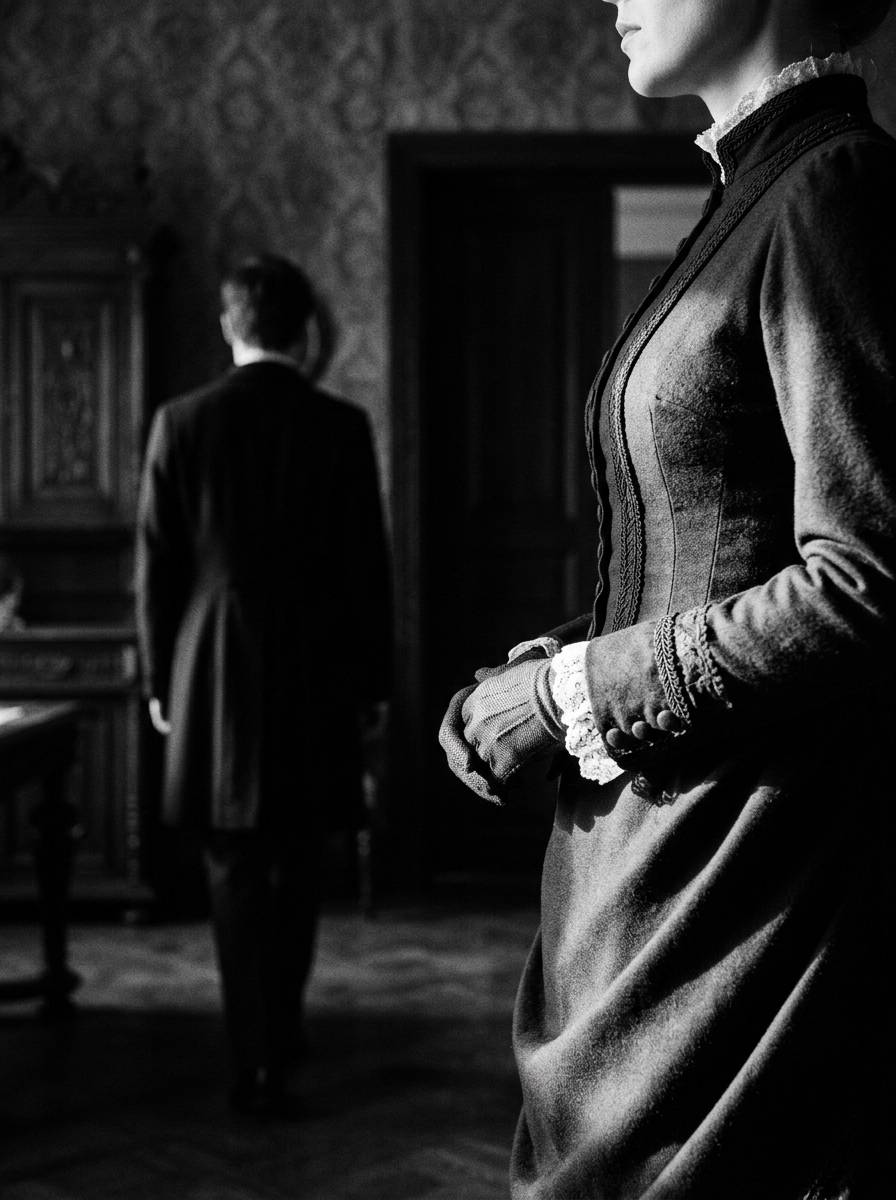
Alyosha walks into Madame Khokhlakova’s drawing room where Ivan and Katerina are finishing a conversation. Katerina asks Alyosha for validation, then delivers a monologue: she will never desert Dmitri, she’ll follow him forever, be his sister, his friend, his god. Ivan quietly approves. Madame Khokhlakova interrupts — “that’s only for this moment, it’s only yesterday’s insult.” Ivan builds on it: with Katerina’s character, this moment will become a permanent duty she feeds on. Katerina flips instantly from tears to composure at the mention of Moscow. Alyosha blurts out that Katerina loves Ivan, not Dmitri, and loves Dmitri only in laceration. Katerina calls him a holy fool. Ivan stands up and delivers his farewell — she never loved him, she kept him nearby for revenge, she loves Dmitri because he insults her, and if Dmitri reformed she’d leave him. He quotes Schiller and walks out. Katerina collapses into hysterics, then resurfaces composed, hands Alyosha two hundred rubles, and sends him to find Staff Captain Snegiryov — the man Dmitri dragged through the street by his beard — to deliver the money.
What You Need to Know
Friedrich Schiller (1759–1805) — German poet, playwright, philosopher. His obsession was the war between passion and morality — characters torn between desire and duty, idealists who crash into reality, noble souls who self-destruct. Every educated Russian in the 1800s grew up on him; he was THE poet-philosopher of their youth. Each Karamazov quotes Schiller but grabs a different piece: Dmitri takes the ecstasy (“Ode to Joy” twisted into degradation), Fyodor takes the family tragedy (The Robbers — accidentally casting himself as the root of the problem), Ivan takes the cold dignity (The Glove — see below). Same poet, completely different mirrors. By the 1870s quoting Schiller was already a little dated, a little romantic-era — so when these characters reach for him, they’re also reaching backward, for a version of themselves that still believed in something.
“Den Dank, Dame, begehr ich nicht” — German, from Schiller’s ballad Der Handschuh (“The Glove” or “The Gauntlet,” 1797). Means: “Madame, I do not want your gratitude.” In the poem, a lady drops her glove into a lion pit to test whether her knight truly loves her. He retrieves it, then throws it in her face with this line — proving his courage but refusing to be a performing animal for someone who treats love as a power game.
Margin Notes
Sister, friend, god — Katerina’s monologue escalates through three levels without her noticing: sister → friend → “his god to whom he will pray — he owes me that at least.” By the end she’s calling herself “an instrument, a mechanism.” The language shifts from sacrifice to domination.
Three voices, one moment — Alyosha: sincerity equals truth. Khokhlakova: this is just yesterday’s insult talking. Ivan: yes, but she’ll weld herself to it forever.
Ivan’s insult as strategy? — “The more he insults you, the more you love him” — if that’s true, did Ivan just do the most effective thing possible to make her love him?
Highlights
Alyosha's active love paralyzed
“Alyosha’s heart couldn’t endure such uncertainty, because the nature of his love was always active. He couldn’t love passively; if he loved someone, he set about trying to help him. And for that, he had to set himself a goal… But instead of a clear goal in everything, there was only vagueness and muddle, ‘laceration.‘”
The operating system that drives Alyosha — active love requires a clear goal, and this situation has none.
"What if she doesn't love anyone?"
“One more idea came into his mind — suddenly and irrepressibly: ‘What if she doesn’t love anyone, neither the one nor the other?‘”
Alyosha reaches the most radical conclusion possible — then immediately retreats from it.
Katerina's pity confession
“I don’t even know whether I love him now. I feel pity for him: that’s poor proof of love. If I loved him, continued to love him, then perhaps I wouldn’t pity him now; on the contrary, I’d hate him…”
The most honest Katerina has been in the entire novel — examining her own feelings instead of performing them.
"I'll be his god"
“I’ll be his god to whom he will pray — he owes me that at least for his betrayal… I will become nothing but a means for his happiness, an instrument, a mechanism for his happiness, and this will last my whole life”
Katerina describing devotion in the language of domination — instrument, mechanism. She doesn’t hear herself.
The narrator on Katerina's performance cracking
“She was gasping for breath… everything came out very hastily, and too openly. There was much youthful lack of restraint, much that reflected yesterday’s irritation, a need to show her pride; she felt all this herself. Her face suddenly grew dark, and the look in her eyes became ugly.”
She heard herself and didn’t like what she heard. The narrator tells you she knew.
Khokhlakova's bomb
“But that’s only for this moment… And just what is this moment? It’s only yesterday’s insult — that’s what this moment means!”
The comic relief character delivers the most devastating line in the room.
Ivan on Katerina's character
“What for others is merely a promise, for her is an age-old, burdensome, perhaps gloomy, but unceasing duty. And she’ll be nourished by the feeling of this duty fulfilled!”
Ivan doesn’t disagree with Khokhlakova — he builds on her. The suffering is the meal.
The instant flip
“Instead of a poor, insulted young woman, weeping now in the midst of a breakdown in her emotions, there suddenly appeared a woman, completely in control of herself, even extremely satisfied with something, just as if she were overjoyed by something”
Tears gone, no trace. A different person showed up in the same body at the mention of Moscow.
Alyosha falls off a roof
“Call Dmitry now… let him come here and take you by the hand; then let him take brother Ivan by the hand and join your two hands. Because you torment Ivan, simply because you love him… and you torment him because you love Dmitry in laceration… you don’t love him for real… but because you’ve convinced yourself that you do.”
The quietest person in the room says the loudest thing anyone’s said in the novel. Katerina calls him a holy fool — meant as an insult, accidentally true.
Ivan's farewell
“You really love only him. And the more he insults you, the more you love him. That’s your rupture… If he ever reformed, you’d desert him and stop loving him entirely… I’m too young and I loved you too intensely… Afterward I’ll forgive, but for now, I don’t need your hand.”
The first time Ivan is fully unmasked. No philosophy, no games. Pride → analysis → vulnerability, in that order.
Alyosha's grief
“Lise, I’m in serious grief! I’ll return shortly, but I’m in great, great grief!”
The boy who detonated the room now has to carry the wreckage.