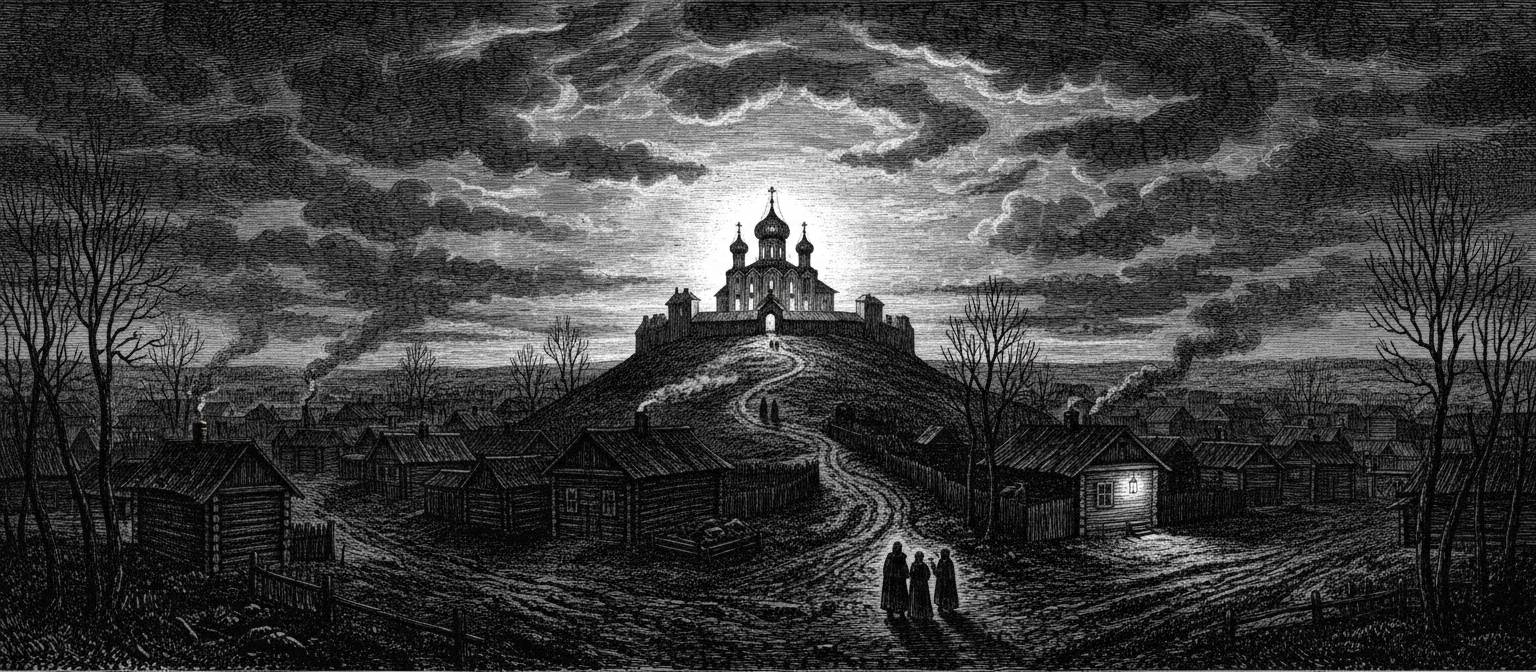
The Brothers Karamazov
Author: Fyodor Dostoevsky
Translator: Michael R. Katz
Started: Jan 31, 2026 04:19 PM
Finished:
Library:
Current Position: Part 2, Book 4, Chapter 6 — “Laceration in a Peasant Hut”
Reading Sessions
| Part | Books | Notes |
|---|---|---|
| Part 1 — The History of a Certain Family | Books 1–3 | ✅ Complete |
| Part 2 — Lacerations | Books 4–6 | ⏳ In progress |
| Part 3 — (not started) | Books 7–9 | — |
| Part 4 — (not started) | Books 10–12 + Epilogue | — |
Background: How It Was Written — serialization history, Dostoevsky’s process, the Pushkin Speech, sources
Summary
Write after finishing — in your own words, what was this book about?
Key Themes
- Faith vs. doubt — the central tension. Each brother represents a different relationship with God
- The problem of suffering — if God exists, why do innocents suffer? Ivan’s rebellion isn’t atheism, it’s rejecting God’s world while accepting He might exist (similar to questioning qadr in Islam)
- The sins of the father — every problem traces back to Fyodor’s abandonment
- Performance vs. sincerity — the novel’s hidden spine. Fyodor performs buffoonery, Katerina performs noble sacrifice, Grushenka performs sweetness, monks pre-arrange fake confessions. Even Zosima’s system designed to strip away performance gets gamed. The disease is universal
Orthodox Christianity — What You Need to Know
Not a theology course. Just enough to read this novel without getting lost.
The Core Difference from Western Christianity
Orthodox faith is experiential, not legalistic. You don’t reason your way to God — you feel Him through beauty, ritual, suffering, and love. Icons aren’t decoration, they’re windows into heaven. The liturgy isn’t a lecture, it’s participation in the divine.
Icons
An icon (ikona) isn’t religious art — it’s a sacred object. Orthodox theology says an icon makes the holy person present. When you pray before an icon of the Mother of God, you’re not looking at a painting — you’re in her presence. Kissing an icon is an act of communion. Spitting on one is an act of spiritual violence — comparable to desecrating the Quran.
Feasts of Our Lady (Bogoroditsa)
The Orthodox calendar has major feast days for the Virgin Mary — her birth, the Annunciation, the Dormition (her death/assumption). Observing them means fasting, attending long services, and intensified prayer. A person observing these feasts is in their most devout, most vulnerable spiritual state.
The Klikushi (“Shriekers”)
A well-documented phenomenon in Russian peasant culture — mostly women. Triggered by intense spiritual or emotional pressure: during church services, in the presence of icons, or under prolonged abuse.
What happens physically:
- Sudden involuntary shrieking — raw sound, sometimes animal-like
- Convulsions — the body seizes, thrashes, limbs go rigid or flail
- Falling to the ground, being “cut down” mid-standing
- Wringing hands, covering the face — a repeating gesture pattern
- Full-body trembling lasting minutes
- Sometimes speaking in altered voices (which fed the possession interpretation)
After the fit: total exhaustion, sometimes unconsciousness. Episodes recur — it becomes chronic, not one-time.
What people believed:
- The church often said demonic possession — evil spirits reacting to holy presence
- Folk belief said a curse or the evil eye
- 19th-century doctors called it hysteria — the body expressing trauma it can’t verbalize
- Dostoevsky’s view leans medical but with compassion — suffering that has no other outlet, so the body screams what the mouth can’t say
The condition can be hereditary. It’s not madness — it’s the body carrying what the mind can’t hold.
Repentance (Pokayanie)
No loopholes, no technicalities. You sin → you repent with your whole being (prostrations, tears, fasting, confession). Orthodox faith says: the suffering of repentance is the point, not an obstacle to be reasoned away. Logical shortcuts around guilt are antithetical to this tradition.
Elders vs. Institutions
An elder (starets) isn’t appointed by the hierarchy — he’s recognized by the people. His authority is spiritual, not administrative. Institutional religion and genuine holiness don’t always overlap — a tension the novel keeps returning to.
The Monastery — Context
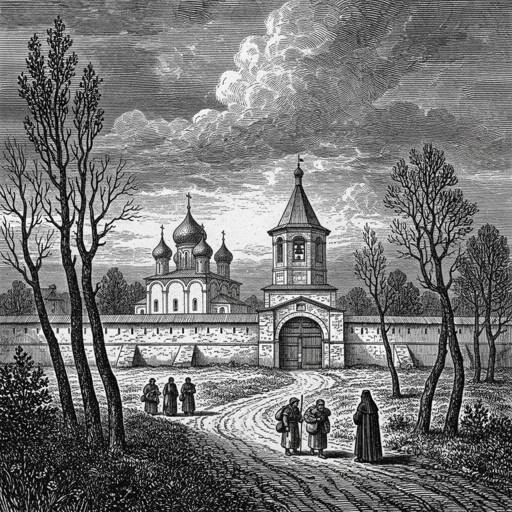
The monastery is based on Optina Pustyn, a real place Dostoevsky visited in 1878 after his son Alyosha died. He met the elder Amvrosy there — the model for Zosima.
Hierarchy
- The Abbot (Father Superior) — runs the official institution, handles administration
- The Elder (starets) — spiritual authority, operates somewhat independently; not every monastery had one
- Hieromonks — monks who are also ordained priests (can perform sacraments)
- Regular monks — took full vows, committed for life
- Novices — probationary period before taking vows (typically 1-3 years)
Daily Life
- Prayer services at set hours (similar to how the five daily prayers structure a Muslim’s day)
- Work — cooking, cleaning, farming, copying manuscripts
- Attending to elders — Alyosha specifically serves Zosima
- Receiving visitors — elders see laypeople for counsel; monasteries were community institutions, not isolated
The Father Superior’s Dining Room (Ch 8)
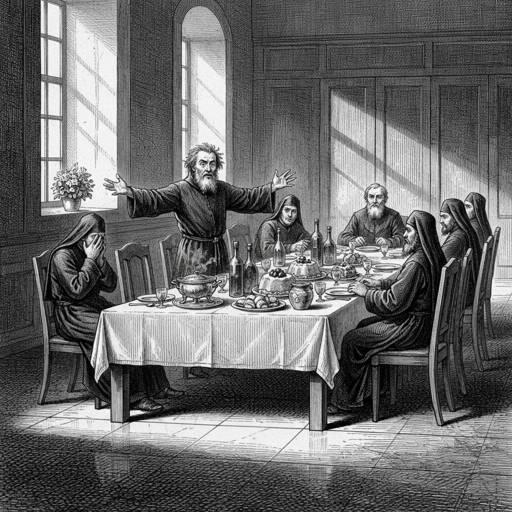
- Two rooms, larger and more comfortable than Zosima’s cell — institutional respectability vs. spiritual austerity
- Mahogany furniture covered in leather (1820s style), unpainted floors, spotless cleanliness, flowers on windowsills
- Table: clean tablecloth, sparkling dishes, three kinds of fresh bread, two bottles of wine, monastery honey (three jars), monastery kvass (famous locally), no vodka
- Five courses (per Rakitin’s snooping): fish soup with sterlets and fish pastries, boiled fish (special recipe), salmon cutlets, ice cream and fruit compote, blancmange
Why the Elder Tradition Almost Died — Three Disruptions (Ch 5)
- Mongol/Tatar Invasion (1237–1240s) — devastated Russia for ~250 years (“the Tatar Yoke”), destroyed monasteries and broke the elder-to-disciple chain of transmission
- Fall of Constantinople (1453) — severed Russia’s connection to the Eastern Orthodox source. The elder tradition originally came from Byzantine monasteries and Mount Athos; with Constantinople gone, the transmission line was cut
- Time of Troubles (1598–1613) — Russia nearly collapsed as a state. Famine, civil war, Polish occupation of Moscow. Monasteries survived but couldn’t flourish
Revival: In the late 1700s, a monk named Paisius Velichkovsky traveled to Mount Athos, rediscovered the old traditions, translated Greek texts, and brought them back to Russia. Optina Pustyn became the center of this revival in the 1800s — making Zosima’s role feel fragile and precious, not guaranteed
The Karamazov Family Tree
Keep this handy. Russian names are confusing.
Fyodor Pavlovich Karamazov (the father)
First Marriage: Adelaida Ivanovna Miusov (died)
- Dmitri (Mitya) — age ~28, eldest son
Second Marriage: Sofia Ivanovna (died)
- Ivan — age ~24, middle son
- Alexei (Alyosha) — age ~20, youngest son
Illegitimate Son (rumored):
- Pavel Fyodorovich Smerdyakov — born to “Stinking Lizaveta,” raised by servants
Key Outsiders
- Pyotr Alexandrovich Miusov — Adelaida’s cousin, raised Dmitri briefly
- Efim Petrovich Polenov — provincial marshal of nobility, took in Ivan and Alyosha after Sofia’s death (narrator says remember him)
- Grigory & Marfa — old servants who raised Smerdyakov
- Elder Zosima — monk at the monastery, Alyosha’s spiritual father
- Rakitin (Mikhail) — young seminarian at the monastery, sharp and clever but self-interested; has feelings for Katerina Ivanovna
- Father Ferapont — elderly monk (~75), Zosima’s polar opposite. Lives alone in a decrepit cell by the apiary, eats two pounds of bread every three days, wears thirty-pound iron chains under his coat. Still tall, strong, athletic build, thick dark hair, large protruding gray eyes. Speaks in northern dialect (okanye). Wears a reddish peasant coat with a rope belt, blackened shirt he never removes, bare feet in worn-out shoes. Treated as holy fool or ascetic — the ambiguity is the point. Claims to see devils on monks and converse with the Holy Spirit. Many brothers sympathize with him; dangerous opponent to the institution of elders
- Madame Khokhlakova — wealthy widow. Owns three properties: an estate in another province (her largest), a house in Moscow, and a handsome two-story stone house in town inherited from her forebears — one of the best in town. Nervous, dramatic, drops French mid-sentence
- Lise (Khokhlakova) — Madame Khokhlakova’s daughter, confined to a wheelchair. Sharp, commanding, theatrical
- Dr. Herzenshtube — the town doctor. Running joke: always comes, examines, says he “can’t understand a thing”
- Katerina Ivanovna — → see full section below
- Grushenka (Agrafena Alexandrovna) — → see full section below
The Karamazov Brothers — Tracking Each One
Dmitri, Ivan, Alyosha, (Smerdyakov). How do they differ? Where do they overlap?
Dmitri (Mitya)
- Bounced between guardians — Miusov briefly, then others. Neglected at every stage
- Alyosha got closer to him more quickly than to Ivan, despite barely knowing him
- The Madonna/Sodom thesis — beauty as a battleground, feeling the divine and degraded from the same source. “The battlefield is the heart of man” → Ch 3
- The “insect” self-identification — receives Joy in its lowest form, as raw lust. Can’t renounce it because even his worst impulses feel sacred → Ch 3
- The Katerina Ivanovna origin — the cruel proposition, the five-thousand-ruble bond, her prostration. Almost killed himself from ecstasy, not guilt → Ch 4
- Engaged to Katerina but consumed by Grushenka. Knows Katerina “loves her own virtue, not me” → Ch 5
- Beat his father bloody, kicked his face — then promised to come back and finish it → Ch 9
- The disgrace on his chest — something physical, a plan worse than anything he’s done, and he won’t stop it → Ch 11
- Under the willow tree, inventoried hanging materials. Alyosha’s arrival flipped suicide into a joke in three seconds → Ch 11
Ivan
- Supported himself writing newspaper articles during university; by graduation, was publishing book reviews and had built connections in literary circles
- Published a controversial article on ecclesiastical courts — both religious and secular sides claimed it supported their view; nobody could pin down his actual position
- His core logic: morality requires God. With God, the church should be everything. Without God, everything is permitted. Two sides of the same coin — he argues both with equal precision and won’t reveal which side he’s on
- Zosima read him instantly: “this question is not resolved in you, and that is the source of your great anguish” — Ivan blushed → Book 2, Ch 6
- Kicked Maksimov off the carriage — first crack in the polished mask → Book 2, Ch 8
- “One viper devours another” — whispered with a malicious expression, then rebuilt the same impulse as cold philosophy in the courtyard → Ch 9
- “I allow myself complete leeway” — he’ll stop a murder with his hands but won’t stop one in his heart → Ch 9
- Fyodor fears Ivan more than Dmitri. Can’t articulate why, but senses cold calculation is more lethal than hot rage → Ch 9
Alyosha
-
Earliest memory: his mother holding him up to an icon of the Mother of God, weeping and praying — this raw, emotional faith (not intellectual) is what draws him to the monastery → Ch 4
-
Dostoevsky explicitly calls him a realist — not a dreamer or naive believer. His faith is grounded, not escapist → Ch 5
-
Inherited his mother’s klikushi response — broke down in the same hysterical fit when Fyodor described spitting on the icon → Ch 8
-
Reads people with quiet precision — caught Rakitin’s feelings for Katerina before Rakitin admitted them, sensed “too much ecstasy” in Katerina’s Grushenka performance → Ch 7, Ch 10
-
“Your heart is better than your head” — the simplest, truest thing anyone says to Fyodor → Ch 8
-
Chose to stay at the monastery and break every promise he made in town, when he learned Zosima was dying → Ch 11
Smerdyakov
- Born to “Stinking Lizaveta” in Fyodor’s bathhouse, raised by Grigory and Marfa — “without any feeling of gratitude”
- As a child, hung cats and performed mock-Orthodox funerals over them — bedsheet surplice, pretend censer
- At twelve, found the logical contradiction in Genesis (light on day one, sun on day four) — Grigory’s answer was a slap. First epileptic fit one week later
- Sent to Moscow to train as a cook. Returned aged, sallow, immaculately dressed — spends his entire salary on wardrobe and perfume. The son of “Stinking” Lizaveta scrubbing his origin off his skin
- Fyodor trusts him absolutely with money — the only person in the house he does
- The narrator compares him to the peasant in Kramskoy’s The Contemplator — not thinking, just absorbing. Could become a pilgrim or an arsonist. Or both
- → Deep dive: Part 1, Ch 6
Father Karamazov
Fyodor Pavlovich — what makes him tick? Track his provocations.
- Deliberately kept Dmitri ignorant about the real value of the estate, then sent small payments over time to drain the inheritance — essentially conned his own son (Ch 2, “remember this”)
- Flips people’s insecurities back at them — exposed Miusov’s fear of being judged by the monks despite claiming to be above religion (Book 2, Ch 1)
- The worst person in the room but the only honest one — doesn’t pretend to be anything he’s not
- Casts his family as characters from Schiller’s The Robbers: Ivan = Karl (the noble favorite), Dmitri = Franz (the villain), himself = Count von Moor (the father). Skips Alyosha entirely. The irony: in Schiller’s play, it’s the father’s failures that cause both sons to spiral. Fyodor accidentally cast himself as the root of the problem. (Book 2, Ch 6)
- Psychology of doubling down (Ch 8): “I did something indecent to him, and since then I’ve hated him” — people hate the ones they wronged, not the ones who wronged them. And: “If I started it, I will finish it” — when he can’t be redeemed, he destroys the room instead
- Almost believes his own performance — invents grievances about the monastery, nearly weeps from simulated emotion, then piles on more nonsense knowing it’s nonsense (Ch 8)
- His drawing room (Book 3, Ch 6): “The furniture was ancient, white, and upholstered with old red silky material… On the walls, covered in white wallpaper, torn in many places, were two large portraits, one of some prince or other… icons on display in the front hallway, before which a lamp was lit at night … not so much out of reverence, but so that the room would be well lit.” Goes to bed at 3–4 AM pacing alone. “Fyodor Pavlovich had a rather large collection of books, more than a hundred volumes, but no one had ever seen him reading.”
Katerina Ivanovna
Dmitri’s fiancée. Track her performances and her perceptions.
- Daughter of a military officer, educated at a women’s institute — polished, French-speaking, very conscious of social rank
- Lives in a spacious, comfortable house on Bolshaya Street with two aunts (one her half sister Agafya Ivanovna’s aunt, the other a Moscow lady) — both defer to Katerina in all things, present “for reasons of etiquette”
- Answers to a benefactress, a general’s widow in Moscow — obliged to write her two detailed letters every week
- Tall, pale with a pale yellow elongated face, large shining dark eyes, charming lips — “something with which his brother could fall terribly in love, but which perhaps it was impossible to love for very long”
- Proud, authoritative, self-assured — Alyosha’s first impression. Second impression: “genuine magnanimous goodness” — she glows differently when she has a plan
- Wrote Dmitri a letter proposing marriage: “I’ll be your furniture, the carpet on which you tread… I want to save you from yourself.” He carries it everywhere → Part 1, Ch 5
- Reverse-engineers Dmitri’s psychology from a single word’s emphasis — accurate observation leading to delusional conclusion: “he’s in despair, I can save him” → Ch 10
- “Let him be ashamed before everyone else, but not before me” — she doesn’t want to fix his shame, she wants to be exempt from it. Possession, not love → Ch 10
- Invited Grushenka as her “angel” — kissed her hand three times. The performance collapsed when Grushenka refused to kiss back → Ch 10
- The real wound wasn’t the refused kiss — it was learning Dmitri told Grushenka about the night she came to his apartment → Ch 10
- Her house (Book 3, Ch 10): Large room, elegant and abundant furniture — sofas, couches, little divans, large and small tables. Paintings on the walls, vases and lamps on tables, flowers, an aquarium near the window. Silk mantilla on the divan, crystal plate with Málaga raisins, biscuits, unfinished cups of chocolate. Two candles brought in at twilight. Provincial wealth aspiring to cosmopolitan taste.
Grushenka (Agrafena Alexandrovna)
The woman both Dmitri and Fyodor are chasing. Track who she actually is.
- Twenty-two years old. Rather tall, a little shorter than Katerina Ivanovna. Plump, with soft, “seemingly inaudible” movements — feline
- Very pale, pink-tinged cheeks. Broad face, lower jaw protrudes slightly. Thin upper lip, swollen-looking lower lip twice as full. Dark brown hair, sable-colored eyebrows, blue-gray eyes with long lashes — the kind of face that stops a stranger in a crowd
- Childlike, openhearted expression — “she regarded things like a child, rejoiced like a child.” But the body suggests the Venus de Milo “in somewhat exaggerated fashion”
- Speaks in a drawling, sugary manner — intentionally lengthening syllables, “bad taste, bearing witness to her unrefined upbringing and her vulgar sense of decency.” Contradicts her childlike eyes completely
- Backstory (told by Katerina): fell in love with an officer five or six years ago, sacrificed everything for him, he forgot her and married someone else. She nearly drowned herself. An old merchant found her, saved her, became “like a father, a friend, a protector.” The officer is now a widower and has written that he’s coming back — she’s loved only him all this time
- Ivan called her a “wild beast.” In person she seems “the most ordinary and simple creature”
- The refused kiss: held Katerina’s hand to her lips, paused, and said “perhaps I won’t kiss your hand after all. So that you’ll remember.” The cruelest power reversal in Part 1 → Ch 10
- “I have a wicked heart; I’m willful. I made Dmitry Fyodorovich a captive, only to have some fun” — told Katerina the truth. Katerina chose not to hear it → Ch 10
- “I arranged this whole scene for your benefit, Alyoshenka” — the cruelty was a performance for Alyosha. Why? Unanswered → Ch 10
- → First appearance: Part 1, Ch 10
The Grand Inquisitor & Big Ideas
Dostoevsky buries philosophical arguments inside characters. Track them here.
- Faith before miracles (Ch 5): Dostoevsky argues faith doesn’t spring from miracles — miracles spring from faith. A realist who doesn’t believe will explain away any miracle as unknown nature. Belief is a precondition for seeing, not a result of seeing. Uses Doubting Thomas as the example: Thomas already believed “in the inner recesses of his being” before he saw. Similar to how the Quran presents ayat (signs) as visible only “for those who reflect” — the disposition comes first
- Zosima on self-deception (Book 2, Ch 2): Lying to yourself is the root sin. It cascades: lose truth → lose respect → lose love → fill the void with vice. The buffoon (Fyodor) is the extreme case, but the subtle version is the pleasure of being offended — manufacturing grievances that become real vindictiveness. Close to the Islamic concept of muhasaba (self-accounting) as the antidote
- Zosima on grief (Book 2, Ch 3): Two types — silent (withdraws inward) and vocal (wailing that feeds on its own futility, keeps the wound open). Zosima doesn’t fix the mother’s grief — he validates it (“no need to be consoled”) then redirects it: your son is an angel, he sees your tears, he points them out to God. Grief transforms over time: bitter tears → tender tears → quiet joy. He asks the child’s name (Aleksey) — making the boy a person, not an abstraction. Dostoevsky’s own son Aleksey/Alyosha died at three; this scene is autobiographical grief
- Active love vs. love in dreams (Book 2, Ch 4): The path to faith isn’t intellectual proof — it’s active love for real people. Love in dreams = fantasizing about being noble and self-sacrificing, costless and self-flattering. Active love = messy, ungrateful, exhausting work with real humans who won’t thank you. Even confession can be vanity — performing sincerity for an audience. Real sincerity only arrives when the performance collapses
- Ivan’s coin — morality requires God (Book 2, Ch 6): Ivan’s two positions aren’t contradictions, they’re two sides of the same coin. With God → morality is real → the church should be everything. Without God → morality is an illusion → everything is permitted, even cannibalism; egoism and crime become the rational choice. The link between God and morality is the point. Ivan sees it with total clarity but won’t commit to which side he’s landed on
Quotes That Hit
Don’t over-collect. Just the ones that punch.
“If God did not exist, He would have to be invented.” — Voltaire (referenced Ch 4). The central question: can humanity function without God?
“In a realist, faith does not spring from the miracle; rather the miracle springs from faith.” — Narrator on Alyosha (Ch 5). The novel’s thesis in one line.
“The man who lies to himself and listens to his own lies reaches a point where he cannot recognize any truth in himself or in anyone surrounding him, and so he loses all respect for himself and for others.” — Zosima (Book 2, Ch 2). The psychology of self-deception in one chain.
“It’s sometimes very pleasant to be offended, isn’t it?” — Zosima (Book 2, Ch 2). People manufacture grievances because being wronged feels good — gives identity and moral high ground.
“No need to be comforted; do not be consoled… weep then, but every time you do so, remember constantly — your little son is one of God’s angels and is looking down at you and sees you, and is rejoicing in your tears, pointing them out to the Lord God.” — Zosima to the grieving mother (Book 2, Ch 3). He doesn’t stop her grief — he redirects it. The child’s name is Aleksey — same as Alyosha, same as Dostoevsky’s own son who died at age three. This isn’t fiction. It’s Dostoevsky processing his own loss.
“People are made for happiness, and anyone who is truly happy has earned the right to say to himself, ‘I have brought about God’s will on this earth.’ All righteous men, all saints, all holy martyrs — they were all happy.” — Zosima (Book 2, Ch 4). A dying monk saying happiness IS God’s will. Martyrs weren’t just enduring — they were happy.
Questions / Things I Don’t Get
Mark confusion honestly. Revisit later or bring to discussion.
My Reactions
“This reminds me of…” / “I disagree because…” — your voice matters
- Ivan the possible non-believer wrote an argument the monks love, while the clerical authority (a churchman) wrote the position the monks reject. Institutional religion and genuine faith don’t always line up. I find this very true. (Book 2, Ch 5)
Connections to Notes from Underground
The Underground Man is a prototype for Ivan Karamazov. Note echoes as you read.
Illustration Style
Art style: 19th century Russian literary illustration — black and white mezzotint print, smooth tonal rendering, dramatic chiaroscuro lighting. NOT crosshatched ink drawing (too sketchy) and NOT engraving (triggers borders from Gemini).
What works in prompts:
- “mezzotint print, smooth tonal rendering, dramatic chiaroscuro lighting”
- “Very dark overall, dramatic shadows”
- “Smooth deep shadows, no visible texture, no crosshatching, just solid darkness”
- “Smooth gradual tonal transitions from light to dark. Refined detail only in the lit areas”
- “No borders, no frame, no vignette. Black fills the entire canvas edge to edge”
What to avoid in prompts:
- “Doré” (triggers rounded corner vignette borders)
- “engraving” (also triggers borders)
- “crosshatched ink drawing” (produces sketchy hand-drawn look, not the smooth dark style)
- “pen and ink” (same problem)
Composition rules:
- No faces — show posture, silhouette, setting instead
- Single light source — candle, lamp, window, doorway. Everything else pure black
- Discuss caption first (it dictates the image), then composition with the user
- Start with free model to test composition, switch to pro for final quality
Captions:
- Dark, punchy, direct Dostoevsky quotes
- No character names — mystery over explanation
- The caption should be the best line from the chapter — a character reveal, the moment someone accidentally tells you who they are
Aspect ratio: 3:4 for plates, 1:1 for square compositions
Discussion Points
Things to talk about — with others or yourself
After Finishing: What Did I Learn?
What changed in how I think?