Part 1 — The History of a Certain Family
Book 1 — A Nice Little Family (Ch 1-5)
Ch 1 — “Fyodor Pavlovich Karamazov”
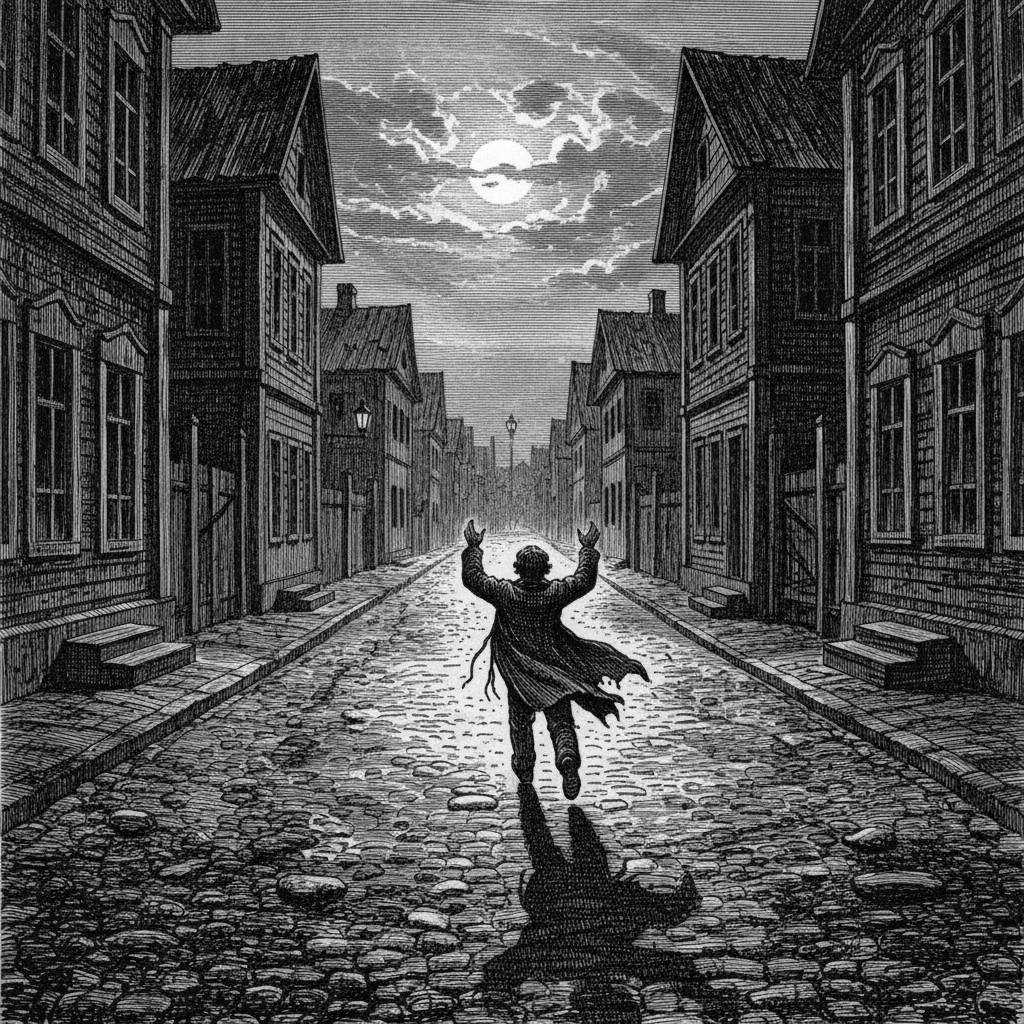
The narrator introduces Fyodor — a man “utterly worthless and depraved” yet shrewd enough to die with a hundred thousand rubles. His first wife Adelaida Ivanovna Miusov married him on a romantic impulse — rebellion disguised as love. She quickly despised him. Fyodor grabbed her dowry at once (twenty-five thousand rubles, gone), and she fled with a seminarian, leaving three-year-old Mitya behind. After Adelaida’s death in a Petersburg attic, Fyodor ran through the streets shouting “Lord, now lettest Thou Thy servant depart in peace” — but also wept “like a little child.” The narrator’s verdict: “He rejoiced at his liberation and wept for his liberator, at the same time.”
Margin Notes
Karamazov duality — both reactions are true simultaneously. Joy at liberation, grief for the liberator. A man who can feel two contradictory things at once and mean both. The family trait introduced in its purest form.
Ch 2 — “He Gets Rid of His Eldest Son”
Fyodor forgets Mitya exists — literally doesn’t remember he has a child on his own property. Grigory raises the boy in the servants’ cottage until cousin Pyotr Aleksandrovich Miusov intervenes. Miusov — a liberal of the 1840s who almost joined the Paris barricades in 1848 — takes guardianship, then promptly leaves for Paris and forgets Mitya too. The boy bounces through four households. Mitya grows up convinced he has property; Fyodor sends him small installments to keep him quiet, draining the estate’s value. By the time Mitya returns to settle accounts, there’s nothing left — Fyodor even claims Mitya owes him money. “This circumstance led to the catastrophe,” the narrator says.
Margin Notes
The inheritance con — Fyodor didn’t just neglect Dmitri — he actively defrauded him. Kept him ignorant of the estate’s real value, drained it through small payments, then claimed Dmitri owed him money. The whole novel’s central conflict — father vs. son over money, women, and legitimacy — starts here with a con job.
Ch 3 — “Second Marriage and Second Children”
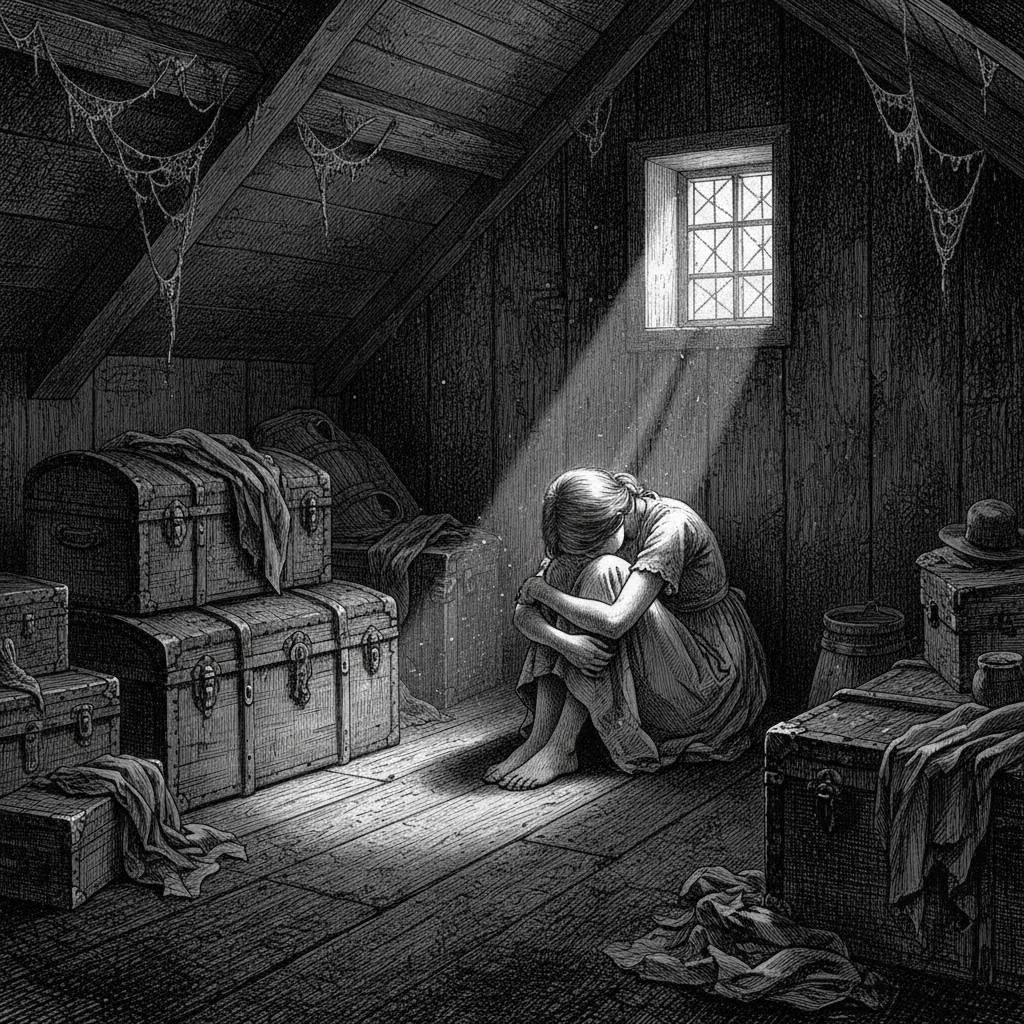
Fyodor’s second wife Sofya Ivanovna — a sixteen-year-old orphan raised by a tyrannical general’s widow, found hanging from a noose in the attic. She trades one tormentor for another. Fyodor is attracted by her “look of innocence,” which “cut into my soul like a razor.” He imports loose women into the house while she’s there. Grigory switches allegiance — defended the first wife’s memory, now defends the second wife in person, even breaking up orgies by force. Sofya develops “the shrieker’s illness” (hysteria) and bears two sons: Ivan and Aleksey. After she dies, the general’s widow storms in — slaps Fyodor’s face, slaps Grigory’s face, wraps both boys in a blanket and carries them off. The marshal Efim Petrovich Polenov takes over their care — “I would ask the reader to take note of this fact,” says the narrator. Ivan’s controversial article on ecclesiastical courts gets published. Ivan arrives at Fyodor’s house and they get along unnervingly well. The whole family is now converging.
Margin Notes
Fyodor and purity — he’s a sensualist excited by innocence itself, wanting to destroy it. The “look of innocence” that cuts like a razor — he doesn’t want Sofya despite her purity, he wants her because of it.
Ch 4 — “The Third Son, Alyosha”
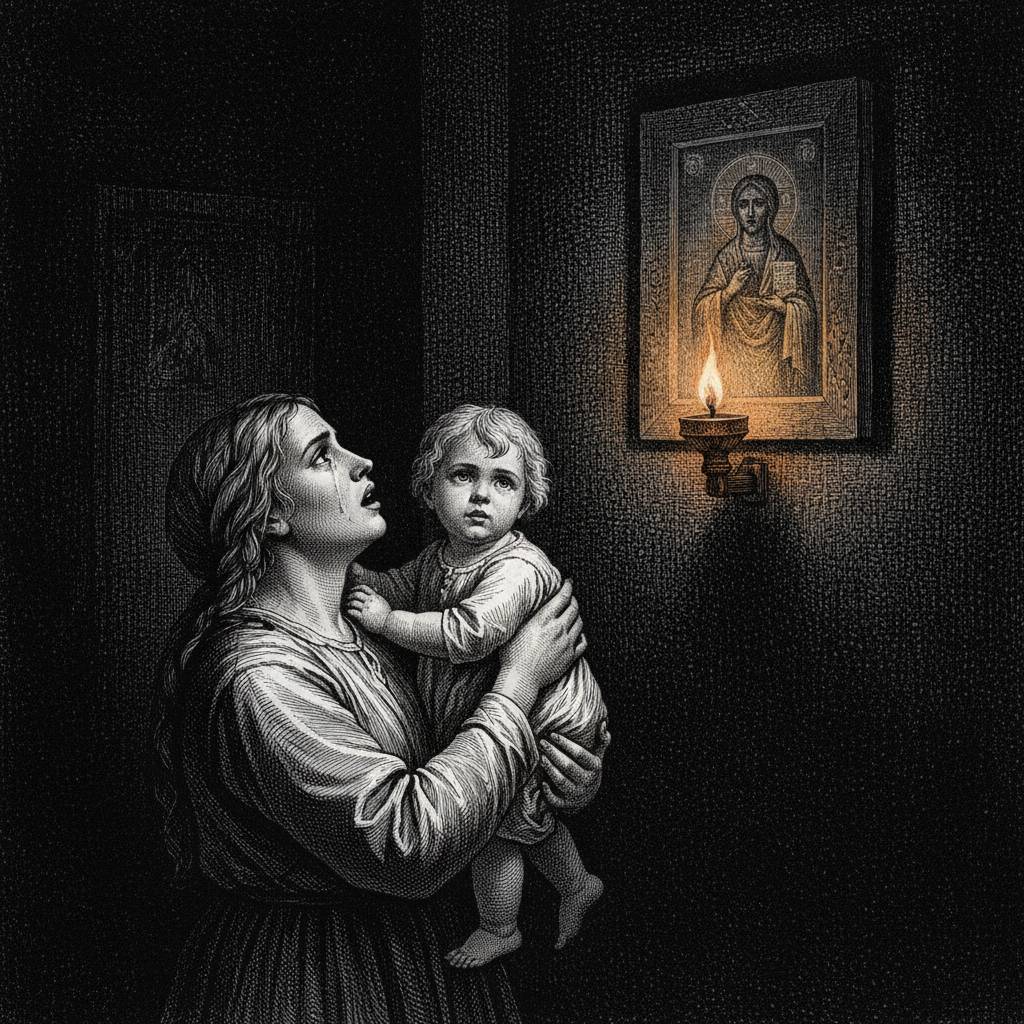
Alyosha’s portrait — the novel’s hero defined. Not a fanatic, not a mystic: “simply an early lover of humanity.” His earliest memory: his mother lifting him before an icon of the Mother of God, sobbing hysterically — “frenzied but magnificent.” At school, boys screamed obscenities in his ears and he’d fall to the floor hiding his face — and they’d stop, feeling compassion, never hatred. He “never considered it an insult,” and that “decidedly captivated and conquered” them. Fyodor’s response to Alyosha’s monastic plan — drunk, sentimental, and strangely sincere. He rambles about hooks in hell, ceilings or no ceilings, and Voltaire’s “If God did not exist, He would have to be invented.” Then: “You’re the only person left on earth who hasn’t condemned me.”
Margin Notes
Wicked and sentimental — “He was sentimental. He was wicked and sentimental.” Two sentences that contain the whole man. Fyodor’s speech to Alyosha is the first time his buffoon mask slips into something genuine — and even that genuine moment is drenched in brandy and self-pity. The sentimentality is real. The wickedness is also real. Same heart, same breath.
Ch 5 — “Elders”
Dostoevsky’s philosophical foundation chapter. He defines Alyosha as a realist — “In a realist, faith does not spring from the miracle; rather the miracle springs from faith.” Alyosha’s logic is absolute — if God exists, live entirely for immortality; if not, become a socialist and an atheist. No half measures. The elder tradition explained: an elder takes your will into his will — total submission as a path to total freedom. The institution nearly died three times (Mongol invasion, fall of Constantinople, Time of Troubles) and was revived by Paisius Velichkovsky via Mount Athos. Zosima is the last in a dying line at this monastery. Alyosha got closer to Dmitri than to Ivan, despite sharing a childhood with Ivan. The whole family + Miusov converging on the monastery. Alyosha dreads it — senses his father will stage a farce. Dmitri writes that he’ll try to restrain himself “in the face of vileness.” Nobody expects it to go well.
Book 2 — An Inappropriate Gathering (Ch 1-8)
Ch 1 — “Arrival at the Monastery”
The day is fine, warm, the end of August. Two carriages: Miusov’s elegant open carriage with young Kalganov (the only one who gives a beggar money, then feels embarrassed about it), and Fyodor’s ancient hired carriage with Ivan. Dmitri is late. Nobody comes to greet them; Miusov stews. The landowner Maksimov appears — a fussy sixty-year-old who runs sideways with “nearly popping” eyes. Fyodor immediately calls him “von Sohn” — a man murdered in a Petersburg brothel in 1870. On the walk through the hermitage gardens, Fyodor needles Miusov about Mount Athos banning all females including hens and cows; Miusov warns him to behave; Fyodor keeps going.
Margin Notes
Miusov’s real stakes — at the door to Zosima’s cell, his inner monologue: “If I’m annoyed, I’ll argue… I’ll lose my temper — and I’ll discredit both myself and my ideas.” His concern isn’t truth or family — it’s his self-image. The worst person in the room is Fyodor, but the most dishonest might be Miusov.
Ch 2 — “The Old Buffoon”
The gathering begins. Zosima’s cell — drab, crude, poor, except for an enormous pre-Schism icon of the Mother of God and expensive Italian engravings beside cheap lithographs. Miusov and Fyodor both refuse to kneel for the elder’s blessing — Miusov from liberal principle, Fyodor by aping Miusov “like a monkey.” Ivan keeps his hands at his sides. Fyodor launches into the ispravnik/napravnik joke, the ticklish wife story, the fabricated Diderot-christening anecdote — filling sacred space with noise. But then a flash: “You see before you a buffoon, verily… It’s just because of my sensitivity that I create an uproar.” Zosima responds with the novel’s first great speech on self-deception. Fyodor kisses the elder’s hand and says “it is beautiful to be offended” — he heard Zosima perfectly. Then immediately pivots to another lie. He can’t stop. The elder leaves smiling: “You shouldn’t be telling any lies.”
Margin Notes
The self-deception chain — Zosima’s speech lays out the cascade: lying to yourself → losing the ability to recognize truth → losing respect for yourself and others → losing love → filling the void with bestiality. The buffoon is the extreme case, but the subtle version is everywhere.
The pleasure of being offended — “It’s sometimes very pleasant to be offended, isn’t it?” People manufacture grievances for the pleasure of moral superiority, then ride manufactured offense into real vindictiveness. Aimed at Fyodor, but it hits Miusov harder — and the reader hardest of all.
Ch 3 — “Peasant Women Who Have Faith”
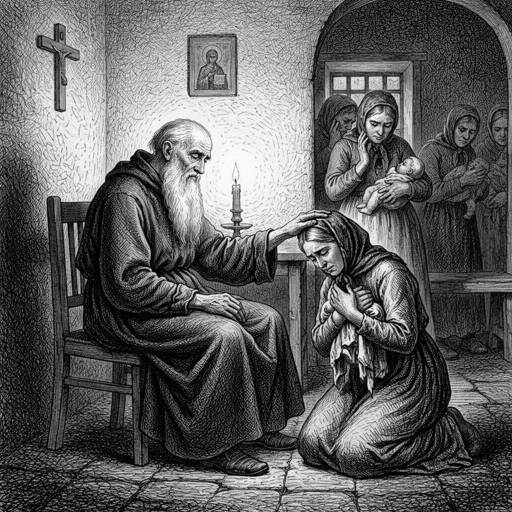
Zosima receives peasant women — three visits that show his range. (1) The grieving mother who lost four sons, last one named Aleksey. Zosima validates her grief, redirects it: “your son is an angel pointing your tears out to God.” (2) The widow who whispers a confession — implied she killed or let her abusive husband die. Zosima: God’s love exceeds any sin, repent and forgive the dead man too. (3) A healthy peasant woman from Vyshegorye — no grief, no guilt, just walked four miles with her baby to check on Zosima and give him sixty kopecks for someone poorer.
Margin Notes
Autobiographical grief — the dead child’s name is Aleksey — same as Alyosha, same as Dostoevsky’s own son who died at age three. This scene isn’t fiction. It’s Dostoevsky processing his own loss through Zosima.
The woman from Vyshegorye — a palette cleanser after the heavy stuff. No grief, no guilt, just love. Dostoevsky shows that Zosima’s world isn’t only brokenness — people just love him.
Ch 4 — “A Lady of Little Faith”
Madame Khokhlakova asks Zosima how to believe in God and the afterlife. Zosima’s answer: active love — don’t think your way to God, love your way there through real service to real people. Khokhlakova says she dreams of being a nurse, kissing wounds — but Zosima distinguishes love in dreams from active love. Then he asks if her confession of vanity was itself vanity — seeking praise for sincerity. She cracks, sees it, and that’s when Zosima believes her. Lise Khokhlakova introduced properly — young, sharp.
Margin Notes
Love in dreams vs. active love — love in dreams is fantasy: costless, self-flattering, imagining yourself noble. Active love is ugly, ungrateful, exhausting work with real humans who won’t thank you. Even confession can be vanity — performing sincerity for an audience. Real sincerity only shows up when the performance breaks down.
Ch 5 — “So Be It! So Be It!”
The ecclesiastical courts debate. Ivan’s article argued the state should be absorbed into the church (not the other way around). The monks (Iosif, Paissy) actually side with Ivan. Miusov sides with the clerical opponent who wants separation. Ivan the possible non-believer makes the argument the monks love, while the churchman wrote the position the monks reject. Dmitri arrives at the end — the gathering is finally complete.
Ch 6 — “Why Is Such a Man Alive!”
Miusov reveals Ivan’s private position: without immortality, no virtue; without God, everything is permitted — even cannibalism. Zosima reads Ivan instantly: “this question is not resolved in you, and that is the source of your great anguish.” Ivan blushes, half-admits it. Fyodor casts the family as Schiller’s Robbers — Ivan as Karl (noble), Dmitri as Franz (villain), himself as the father. The gathering explodes.
Margin Notes
Ivan is a Karamazov too — Miusov watches Ivan walk to dinner untouched by the chaos — “a brazen expression and the conscience of a Karamazov.” The polished intellectual shares the family blood. Just packaged differently.
Ch 7 — “A Seminarist-Careerist”
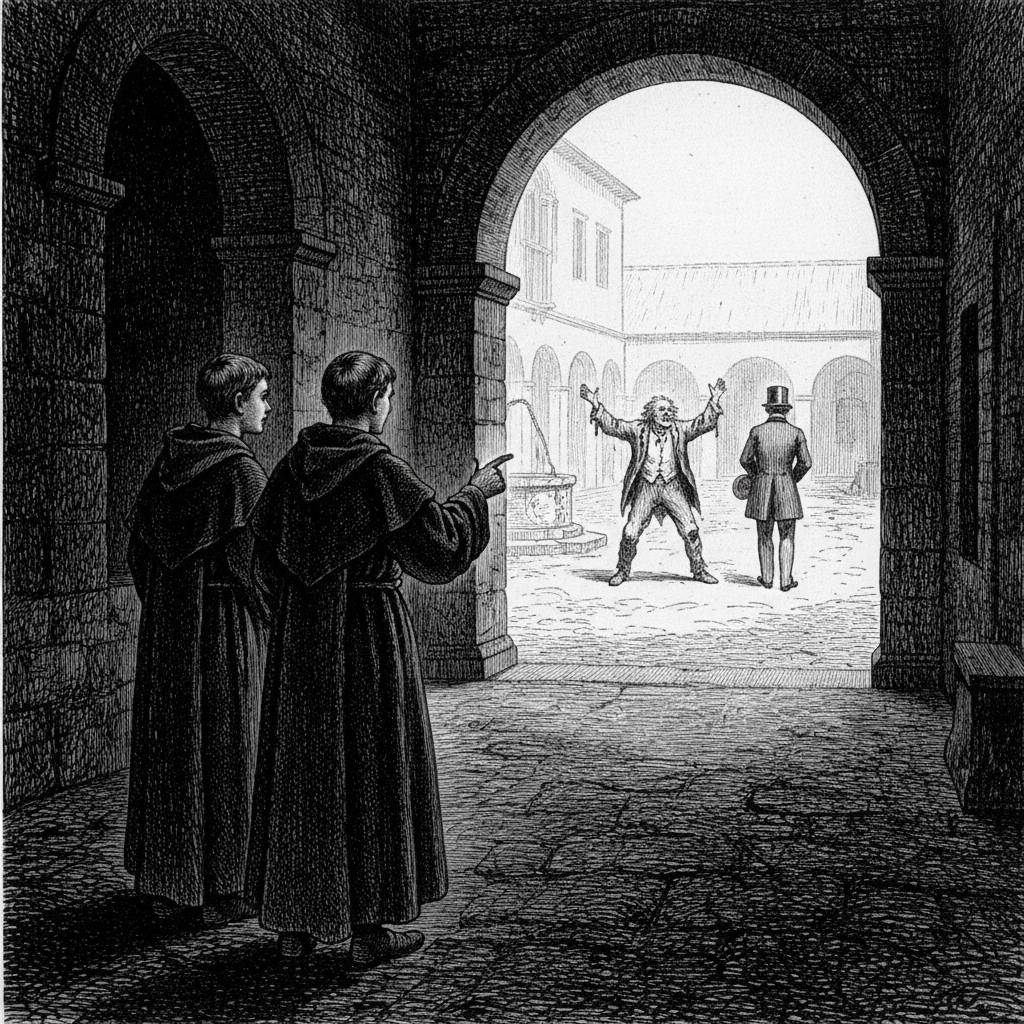
Rakitin introduced properly — a young seminarian, sharp-tongued. Recaps the Dmitri-Fyodor-Grushenka-Katerina Ivanovna mess for Alyosha: father and son competing for Grushenka, Ivan has feelings for Katerina Ivanovna, Dmitri wants out of his engagement. Rakitin predicts murder from Zosima’s bow. Tells Alyosha he’s a Karamazov sensualist too — “from your father a sensualist, from your mother a holy fool.” Alyosha doesn’t deny it but doesn’t let it control him. Alyosha quietly catches Rakitin’s feelings for Katerina Ivanovna and that he’s been visiting her.
Margin Notes
The observer gets observed — Rakitin thinks he’s the analyst in the room, but he keeps getting read by everyone. Ivan predicted his whole career, Alyosha caught his heart. He sees everyone’s game except his own.
Ch 8 — “A Scandalous Scene”
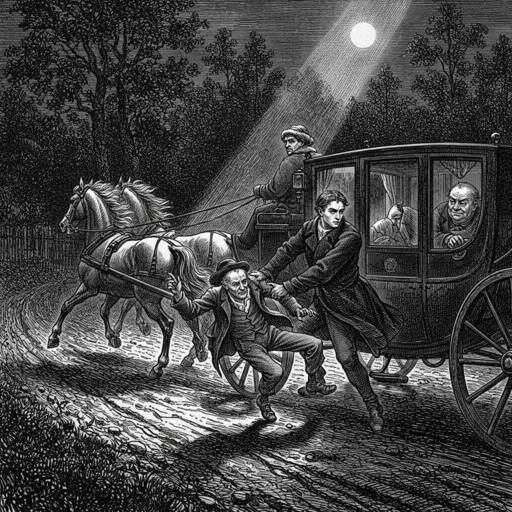
Miusov rehearses being dignified at the Father Superior’s dinner — resolves to be kind, even concede the land dispute. Fyodor almost leaves but turns back: “If I started it, I will finish it.” Crashes the dinner, calls Maksimov “von Sohn,” accuses monks of abusing confession (narrator flags this twice as lies with “nota bene”), attacks their fasting and wealth. Father Superior responds both times with quiet scripture. Fyodor invents grievances about the monastery and nearly weeps from simulated emotion. Threatens to take Alyosha home. On the carriage ride, Ivan silently kicks Maksimov off. Fyodor accuses Ivan of orchestrating the whole monastery visit; Ivan doesn’t deny it. Fyodor calls Ivan “Karl von Moor” again — the Schiller callback.
Margin Notes
Fyodor’s psychology of doubling down — “I did something indecent to him, and since then I’ve hated him.” People hate the ones they wronged, not the ones who wronged them. And: “If I started it, I will finish it” — when he can’t be redeemed, he destroys the room instead.
Fyodor almost believes his own performance — invents grievances, nearly weeps from simulated emotion, then piles on more nonsense knowing it’s nonsense. The line between performing and feeling blurs even for him.
Book 3 — The Sensualists (Ch 1-11)
Ch 1 — “The History of a Servant’s Family”
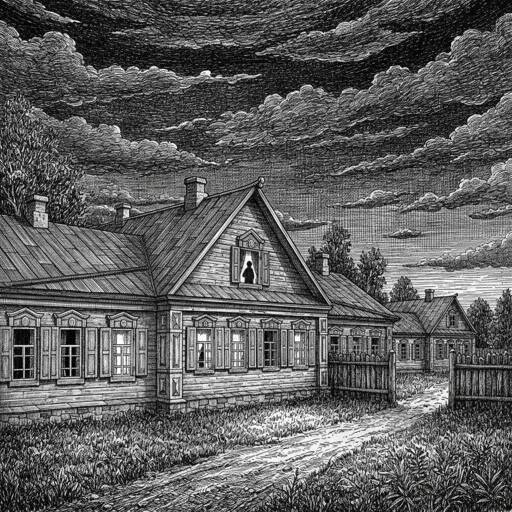
Fyodor’s house introduced — gray, one story with an attic, red iron roof, pleasant outside but full of hidden staircases, cupboards, and storerooms. Built for a large family, occupied by one man. Rats in the walls — “It’s not so boring in the evenings when one is home alone.” Household: Fyodor and Ivan in the main house; Grigory, Marfa, and Smerdyakov in the servants’ lodge. Grigory refused to leave after serfdom ended — “Do you understand what duty is?” During drunken bouts Fyodor feels “spiritual terror and moral shudder” — his soul “quivering in his throat” — and sometimes crosses the courtyard at night just to look at Grigory’s face and exchange a meaningless word.
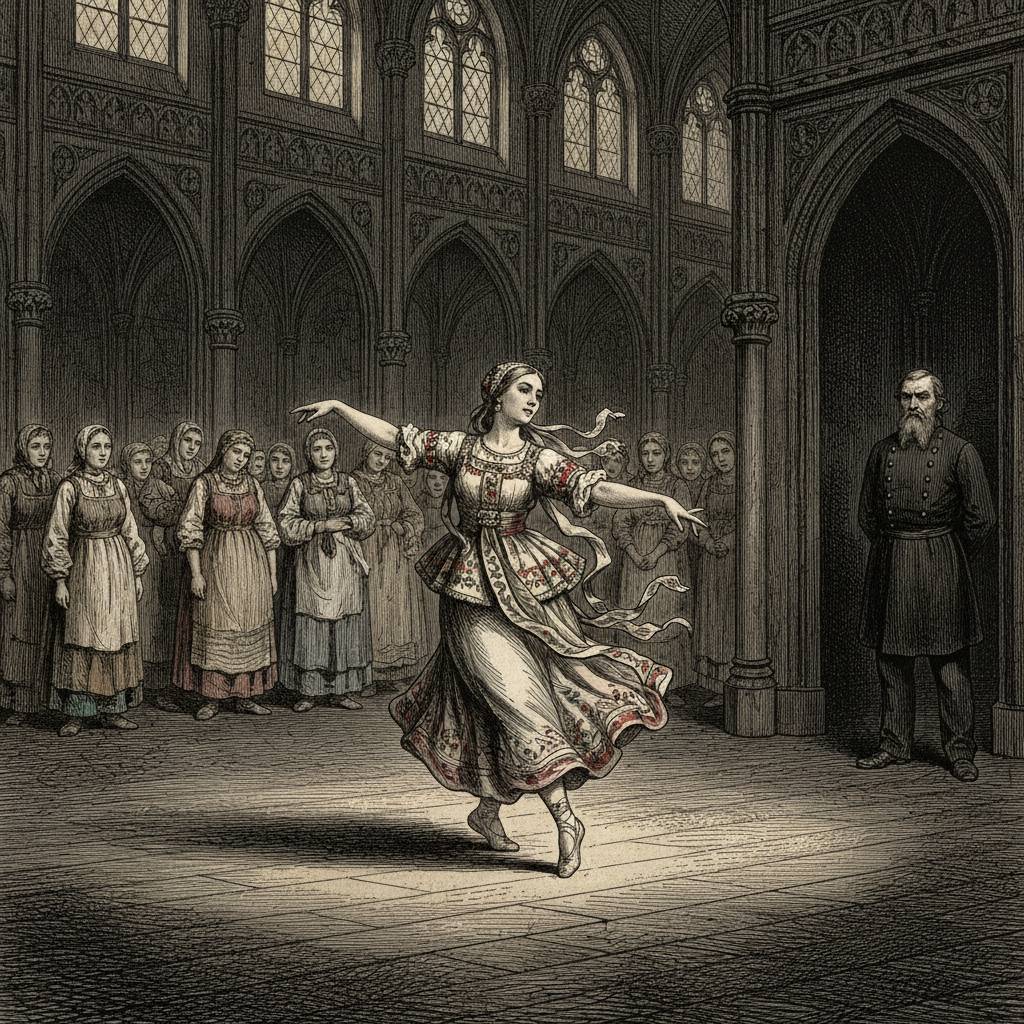
Grigory and Marfa’s marriage: silent, rigid, built on understood hierarchy.
Margin Notes
The house is Fyodor — respectable exterior, chaos underneath. Hidden staircases, cupboards, storerooms. The architecture mirrors the man.
Fyodor needs a witness — he needs Grigory not as a servant but as someone who sees all his depravity, knows every secret, but doesn’t judge or threaten. Alyosha served the same function: “lived, saw everything, and didn’t condemn anything.” But Alyosha added what Grigory couldn’t — love without contempt.
Ch 2 — “Stinking Lizaveta”
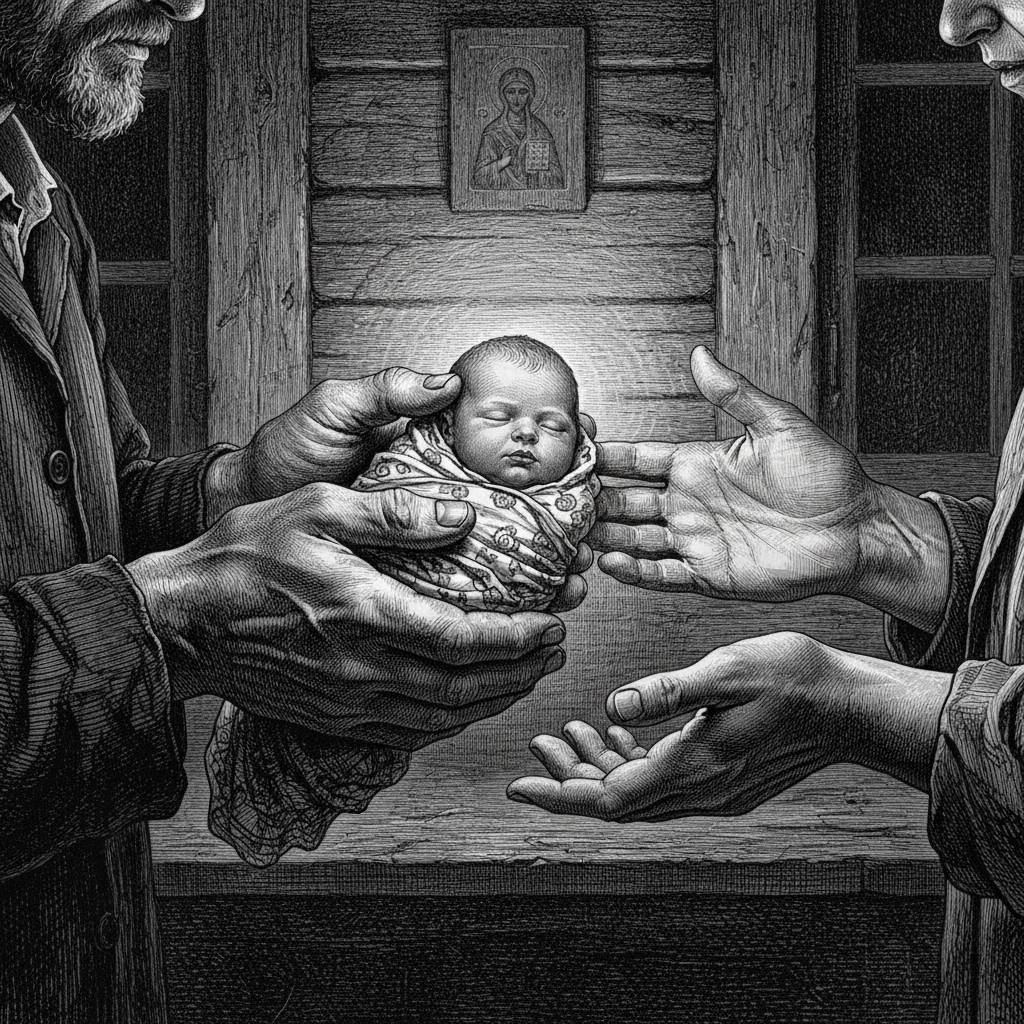
Smerdyakov’s origin story. Lizaveta — a tiny, barefoot, mentally disabled holy fool (yurodivy) loved by the whole town. Gives away every coin and roll she receives. Sleeps outside in all seasons. Her father Ilya beat her; after he died, the town adopted her. A group of drunk men find her sleeping, debate whether she can be “considered a woman” — all say no with “proud loathing.” Fyodor declares yes, “very much so, and there was even something exciting about it.” Five months later she’s pregnant. Grigory defends Fyodor, blames an escaped convict called “Karp the Rifle.” But Lizaveta climbs over Fyodor’s fence to give birth. She dies at dawn. Grigory: “An orphaned child of God is kin to all, all the more so for us. Our little departed one sent us this child; he comes from the devil’s son and a holy fool. Nurse him and weep no more.” The child is christened Pavel Fyodorovich.
Margin Notes
One taken, one given — Grigory connects his dead six-fingered baby to this newborn. The same night one is buried, another appears. He reads it as providence.
The naming cruelty — Fyodor invents the surname Smerdyakov — from Smerdyashchaya (“Stinking”) Lizaveta. Branded his own son with his mother’s degradation as a permanent joke. Every time someone says his name, they say “son of the stinking one.”
The narrator’s sarcasm — he apologizes for spending so long on “common folk” — while having just told the most important backstory in the novel.
Ch 3 — “The Confession of an Ardent Heart. In Verse.”
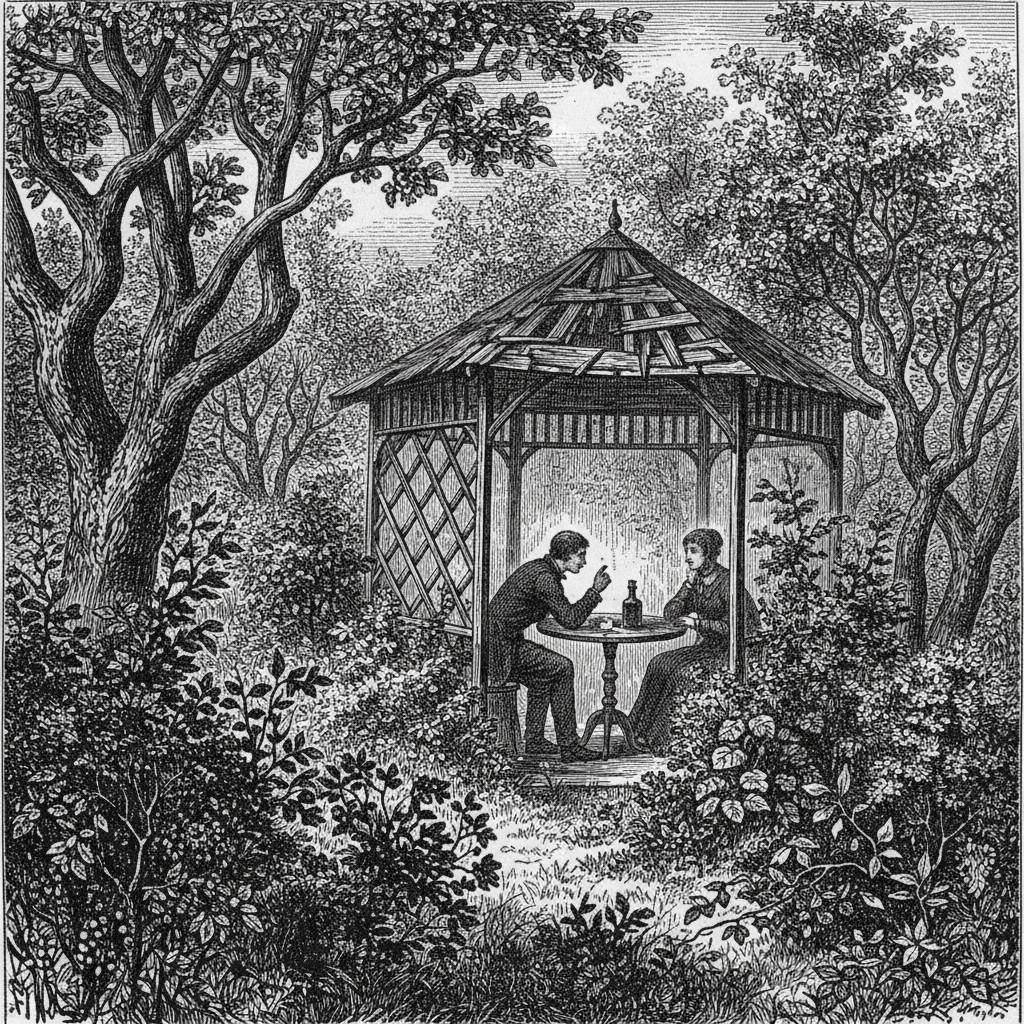
Alyosha heads across town toward Katerina Ivanovna’s. He spots Dmitri leaning over a fence, waving wildly but afraid to shout. They scramble into an abandoned gazebo in the garden. Half a bottle of brandy on the table. Dmitri is electric — feverish, ecstatic, terrified. He needs Alyosha to run an errand: to Katerina Ivanovna, and to their father. But first, he needs to confess everything. What follows is the most poetry-heavy chapter in the novel — Dmitri borrows from Schiller, Goethe, Nekrasov, reaching for language bigger than himself. The whole monologue builds to: “The battlefield is the heart of man.”
Margin Notes
Poems as prayers — Dmitri doesn’t have the words for what’s tearing him apart, so he uses other men’s poems. He’s not showing off — he’s reaching for language bigger than himself. The Madonna and Sodom live in the same heart, and he can’t separate them.
The Poems Dmitri Quotes
I. His own lines — repeated to himself before Alyosha arrived:
Dmitri's private prayer
Glory to God in the world,
Glory to God in me!God is out there in the universe — and also inside him. Two lines, total sincerity, total arrogance. He doesn’t see a contradiction.
II. Nekrasov — “Where from the Gloom of Corruption” (1846):
Nekrasov — a fallen woman's dignity
Don’t believe the worthless, lying crowd,
Forget your doubts…Nikolai Nekrasov (1821–1878) wrote this about a fallen woman — a prostitute — saying: don’t judge her, she has dignity underneath the degradation. Dmitri uses it as a joke (“I’m not really drunk”), but the deeper echo is about himself. He’s about to confess his own ruin and he’s already begging: don’t believe what I look like on the surface. Connection: this same poem is the epigraph to Part II of Notes from Underground — Dostoevsky keeps circling back to the question of whether a degraded person can still be redeemed.
III. Apollon Maikov — “Bas-relief” (1842):
Silenus on his donkey
And Silenus with his ruddy mug
Sat on his stumbling ass—A bas-relief is a carved stone sculpture — Maikov is describing an ancient carving of a Dionysian procession. Silenus is the oldest satyr in Greek mythology — Dionysus’s fat, red-faced, perpetually drunk tutor, always barely staying on his donkey. The comic mascot of excess. Dmitri says “I’m not Silenus, but I’m strong” — a pun, because in Russian Silenus (Силен) and silen (силен, “strong”) sound identical. He rejects the image but keeps the word. He absolutely is Silenus. He’s sitting in a crumbling gazebo with brandy at three in the afternoon.
IV. Schiller — “The Eleusinian Festival” (1798) — the poem that makes Dmitri weep:
The Eleusinian Festival — Ceres finds humanity in ruin
Wild and fearful in his cavern
Hid the naked troglodyte,
And the homeless nomad wandered
Laying waste the fertile plain.
Menacing with spear and arrow
In the woods the hunter strayed…
Woe to all poor wretches stranded
On those cruel and hostile shores!From the peak of high Olympus
Came the mother Ceres down,
Seeking in those savage regions
Her lost daughter Proserpine.
But the goddess found no refuge,
Found no kindly welcome there,
And no temple bearing witness
To the worship of the gods.From the field and from the vineyards
Came no fruits to deck the feasts,
Only flesh of bloodstained victims
Smoldered on the altar fires.
And wherever the grieving goddess
Turns her melancholy gaze,
Man in deepest degradation
Ceres beholds everywhere.The myth: Ceres (Demeter), goddess of harvest, comes down from Olympus searching for her kidnapped daughter Proserpine (Persephone), taken by Hades to the underworld. Instead of finding her daughter, she finds humanity living like animals — cavemen, nomads, hunters. No temples, no beauty, no civilization. Just blood on altars. In the full poem, Ceres eventually teaches humanity agriculture, and from that comes settlement, culture, worship — civilization is born.
Stanza 7 — the answer
Would he purge his soul from vileness
And attain to light and worth,
He must turn and cling forever
To his ancient Mother Earth.If man wants to purge his vileness, he must cling to Mother Earth — return to the soil, the ground, the physical. Redemption starts in the dirt, not the sky. Dmitri reads Schiller in Russian translation by Vasiliy Zhukovsky — not the German original, despite knowing the German title “An die Freude.”
Why Dmitri sobs: he identifies with the degraded caveman. “I think about this humiliated man because I myself am that man.” He knows the poem’s answer — cling to the earth, grow, build something — but he can’t do it. “How can I enter into union with Mother Earth forever? I don’t kiss the earth; I don’t cleave her bosom; should I become a peasant or a shepherd?” He’s an officer, a debtor, a sensualist bouncing between women and taverns. “Cling to the earth” is beautiful advice for a man with no ground under his feet.
V. Goethe — “The Divine” (1783):
Three words
Be noble, man!
One line. A three-word prayer he can’t live up to. Goethe’s poem says humans are the only creatures who can choose to be good — nature is indifferent, but we can distinguish right from wrong. Dmitri knows what he should be. He just said it in three words. And then he keeps drinking.
VI. Schiller — “Ode to Joy” (1785) — yes, that “Ode to Joy,” the one Beethoven set to music in the Ninth Symphony. Dmitri tells Alyosha he wants to begin his confession with this poem. The Russian translation is by Fyodor Tyutchev, another major Russian poet:
Ode to Joy — from angels to insects
Joy everlasting fostereth
The soul of God’s creation,
Her secret force of ferment fires
The cup of life with flame.
Enticed each blade toward the light
And solar systems evolved
From chaos and dark night.Filling the realms of boundless space
Beyond the stargazer’s sight.
At bounteous nature’s breast,
All things that breathe drink Joy,
All creatures, all nations,
She draws in her wake.
Her gifts to man are friends in need,
The wreath, the foaming must,
To angels — visions of God’s throne,
To insects — sensual lust.Joy is the engine of the entire universe — it moves the stars, grows the grass, holds creation together. Everything alive drinks from the same source. But Joy gives different gifts depending on what you are. To humans: friendship and wine. To angels: God’s face. To insects: sensual lust. All from the same divine force.
"Brother, I am that very insect"
“Brother, I am that very insect.”
He receives Joy in its lowest form — as raw lust, as Karamazov sensuality. But it’s still Joy. Still from God. He can’t renounce it because even his worst impulses feel sacred. He can’t purify himself because the beauty and the degradation come from the same place.
What the Poems Build To
All six poems converge on Dmitri’s thesis — the most important paragraph he speaks in the entire novel:
"The battlefield is the heart of man"
“Beauty is a terrible and horrible thing! It’s terrible because it’s indefinable… Man begins with an ideal of the Madonna and ends up with the ideal of Sodom. It’s even worse that a man with the ideal of Sodom in his soul doesn’t renounce the ideal of the Madonna; his heart may be on fire from it… What seems to be a disgrace to the mind seems to be pure beauty to the heart. Is there beauty in Sodom? Believe me, for the vast majority of men, beauty exists in Sodom… It’s awful that beauty is not only terrible, but it’s a mysterious thing. God and the devil are struggling here, and the battlefield is the heart of man.”
Ivan argues the problem of God with his mind. Dmitri feels it in his body. Same crisis, completely different languages. Same Karamazov blood, different battlefields.
“I’m a very uneducated man” — Dmitri says this right after quoting Schiller from memory in German. He’s not uneducated. He’s uneducated by Ivan’s standards. He judges himself by his brother’s measure and comes up short.
Ch 4 — “The Confession of an Ardent Heart. In Anecdotes.”
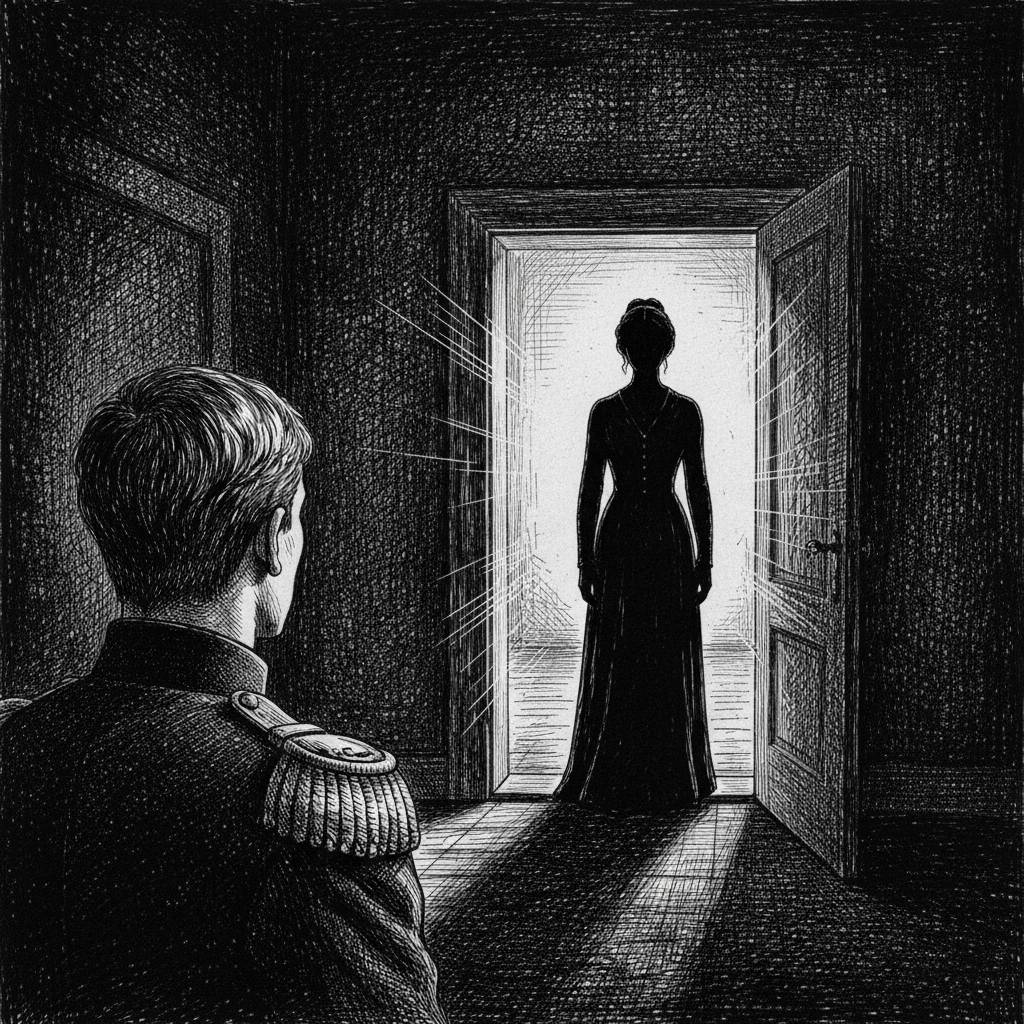
Dmitri shifts from poetry to stories. He admits to his pattern with women — seductions, cruelties, abandoned girls — but dismisses them as lightweight sins, “flowers à la Paul de Kock.” He tells Alyosha about his posting in a frontier town, where a lieutenant colonel commands the battalion. The colonel has two daughters: Agafya (plain, humble) and Katerina Ivanovna (proud, beautiful, from nobility). Dmitri discovers the colonel has been embezzling government funds — lending them to a merchant named Trifonov, who launders them through fairs. When Trifonov refuses to return the money, the colonel is exposed. Dmitri makes a cruel proposition through Agafya: send me your sister, and I’ll give her the money. Then, at dusk, Katerina appears alone at Dmitri’s apartment — the proudest woman in town, trembling, asking for the money. Dmitri feels the predatory Karamazov lust surge — a hatred “only a hairsbreadth away from insane love.” Then he turns, takes a five-thousand-ruble bearer bond from his French dictionary — five hundred more than she asked for — hands it to her silently, and bows deeply. She drops to the floor in a full Russian prostration, forehead to the ground, then runs. Dmitri draws his sword and almost kills himself — not from guilt, but from ecstasy.
Margin Notes
Ecstasy, not guilt — “Do you understand that a man can kill himself from some kinds of ecstasy?” Dmitri nearly kills himself not because he wronged Katerina, but because the beauty of the moment — her pride, his restraint, the silent bow — overwhelmed him. The Karamazov experience of beauty as something physically unbearable.
Ch 5 — “The Confession of an Ardent Heart. ‘Upside Down.‘”
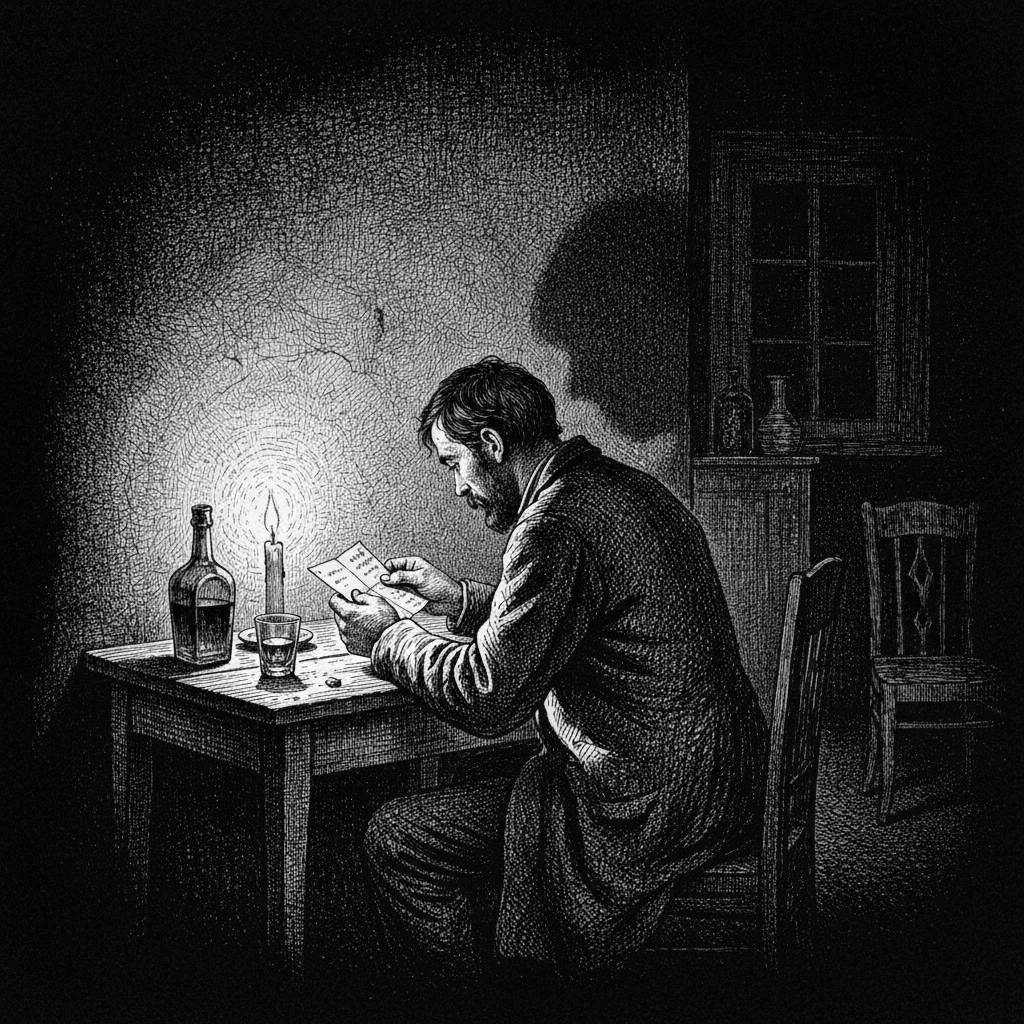
Dmitri finishes his confession — and it turns into a full inventory of the catastrophe. Katerina Ivanovna — his fiancée, proud, wealthy (inherited 80,000 rubles from a general’s widow in Moscow). She wrote him a letter proposing marriage: “I’ll be your furniture, the carpet on which you tread… I want to save you from yourself.” He carries it everywhere. But Dmitri knows the truth — “she loves her own virtue, not me.” The engagement is a performance of noble sacrifice, not love. Grushenka — the woman Dmitri can’t stay away from, a sharp businesswoman under the protection of an old merchant. Both Dmitri and Fyodor are chasing her, and the competition is turning violent. The sealed envelope — Fyodor has prepared three thousand rubles in a sealed packet for Grushenka, tied with ribbon, addressed to her, kept in his house. Smerdyakov is the only one who knows exactly where it is. Dmitri knows it exists. The money, the woman, the father — the collision course is set.
Margin Notes
Who is the general’s wife? — Katerina Ivanovna’s rich relative on her mother’s side, living in Moscow. After her other nieces died, she took Katya in and made her the sole heiress.
How does the promissory note scheme work? — A promissory note is a legal IOU. You sign a paper saying you’ll pay someone a certain amount by a certain date. The paper itself can be handed to anyone — whoever holds it has the right to collect. If you pay, you get the note back and it’s destroyed. If you don’t pay, the holder can take you to court or ruin your reputation.
“In whose honesty he believes, as he does in his own” — Sarcasm. Fyodor measures Smerdyakov’s honesty by his own — and he knows he’s dishonest.
Highlights
Katerina's letter
“I love you madly… Don’t be afraid — I won’t do anything to shackle you in any way; I’ll be your furniture, the carpet on which you tread… I want to love you forever, I want to save you from yourself…”
Katerina’s letter proposing marriage to Dmitri. He carries it everywhere, says he’ll die with it.
"She loves her own virtue, not me."
“She loves her own virtue, not me.”
Dmitri on Katerina — blurted out, then immediately defended her sincerity. Both things true at once.
"She has a noble intellect."
“She’ll understand the true depth of this misfortune and she’ll calm down. She has a noble intellect.”
Alyosha’s faith that reason and goodness will sort things out.
"I believe in miracles."
“I believe in miracles.”
Dmitri sending Alyosha to ask Fyodor for money — knowing it won’t work, going anyway.
Ch 6 — “Smerdyakov”
Alyosha arrives at Fyodor’s house for coffee and cognac. Fyodor introduces Smerdyakov as “Balaam’s ass” — the servant who’s started talking. The narrator pauses to give Smerdyakov’s full portrait: a cruel, silent child who hung cats and performed mock funerals, who asked Grigory where light came from on the first day and got slapped for it. Sent to Moscow to train as a cook, came back aged and immaculate. Fyodor trusts him with money absolutely. The narrator compares him to a peasant in a Kramskoy painting — a man standing in the forest, not thinking, just contemplating. Could go on a pilgrimage or burn down a village. Or both.
Margin Notes
Balaam’s Ass (Numbers 22:21–34) — Fyodor calls Smerdyakov “Balaam’s ass.” In the Bible, an ass sees an angel blocking the path that her master can’t see. The master beats her; the ass speaks and reproaches him; the master finally sees the angel. The dumb animal that sees what the master can’t.
Gogol & Smaragdov — Fyodor gives Smerdyakov Gogol’s Evenings on a Farm near Dikanka (1831) — Gogol’s debut, the most fun and lighthearted book in Russian literature. Smerdyakov: “None of it’s true.” Then Smaragdov’s Universal History — a well-known primary-school textbook by S. N. Smaragdov (1805–1871). Doesn’t finish ten pages
The food inspection ritual — a child told he came from mildew and filth, controlling the one thing he can: what enters his body. Fyodor makes him a cook. Turns neurosis into a job.
Moscow return — spends almost his entire salary on wardrobe, pomades, perfumes. The son of “Stinking” Lizaveta scrubbing his origin off his skin.
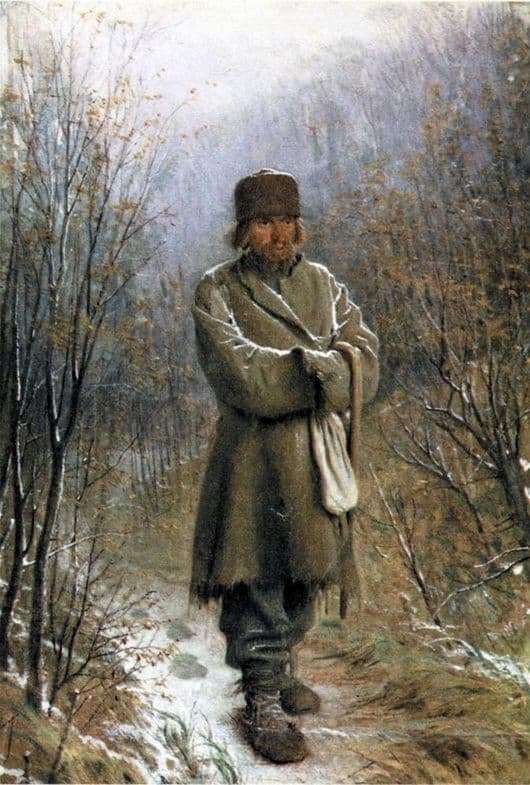
The Contemplator — Dostoevsky compares Smerdyakov to the peasant in Kramskoy’s painting (1876) — not thinking, just absorbing. The distinction between thinking (has direction) and contemplating (collecting impressions without knowing why).
Highlights
Where did the light come from?
“The Lord God created light on the first day, but the sun, the moon, and the stars on the fourth day. Where did the light come from on the first day?”
Grigory’s answer is a slap across the face. One week later — his first epileptic fit.
The food inspection
“He’d sit down to his soup, pick up his spoon, and search in his bowl, bending over it, examining it, picking up a spoonful of soup and holding it up to the light… he’d raise a piece to the light on his fork and examine it as if under a microscope.”
The son of Stinking Lizaveta, immaculate
“He came back from Moscow very well dressed, wearing a fine suit and clean linen; he habitually brushed his clothes meticulously twice a day; and he very much liked to polish his fashionable calfskin boots with special English wax so they’d shine like a mirror.”
Three banknotes in the mud
“Fyodor Pavlovich was drunk and he dropped in the mud in his own courtyard three rainbow-colored, hundred-ruble banknotes… Smerdyakov had picked them up and brought them in yesterday. ‘Well, brother, I’ve never seen anyone like you before.‘”
The Contemplator
“The painter Kramskoy has a remarkable work entitled The Contemplator: it depicts the forest in winter and, on the road, wearing a ragged frock and bast shoes, a man is lost and standing all by himself; he seems to be deep in thought, but he’s not really thinking: he is ‘contemplating’ something.”
Pilgrim or arsonist — or both
“Perhaps, all of a sudden, having collected impressions over many years, he’d ditch all of them and set off on a pilgrimage to Jerusalem, to wander and save his soul; perhaps he might suddenly burn down his native village; perhaps it might transpire that he would do both things together.”
Smerdyakov the contemplator
“There are quite a few contemplators among the common folk. Smerdyakov was probably one of them; he was also perhaps gathering impressions avidly, hardly knowing why he was doing so.”
Ch 7 — “Controversy”
Smerdyakov hijacks a dinner conversation about a martyred soldier and builds a devastating logical argument for why renouncing God under torture isn’t a sin. His reasoning: the moment you think about renouncing, God already excommunicates you — so there’s nothing left to renounce. He then challenges Grigory to move a mountain with faith, proving nobody truly believes. Fyodor is delighted. Grigory is furious. Ivan watches with intense curiosity. Alyosha says Smerdyakov doesn’t possess “true Russian faith.”
Margin Notes
Smerdyakov’s anathema paradox — the moment you think about renouncing God, He cuts you off, so you’re no longer Christian, so there’s nothing to renounce. A loophole built from God’s own rules against Him.
The mountain challenge — weaponizes Matthew 17:20 against Grigory: if you really believe, move the mountain. You can’t? Then you don’t believe either. Nobody does — except maybe two hermits in a desert.
“Very Russian” — Fyodor recognizes Smerdyakov’s pattern: demolishing all faith while still believing two hidden saints carry it for the whole world. Ivan and Alyosha both agree the pattern is Russian.
“Casuist” and “Jesuit” — Fyodor names Smerdyakov’s method. Casuistry = technically valid logic used to reach morally wrong conclusions. The Jesuits were famous for it.
Highlights
Smerdyakov's opening argument
“It’s because, sir,” he blurted unexpectedly in a loud voice, “that if this praiseworthy soldier’s feat was so great, sir, then, in my opinion, there would have been no sin if, in this occurrence, he’d renounced the name of Christ, so to speak, and even denied his own christening, and, by so doing, saved his own life for future good deeds, which, in the course of years, he’d do as penance for his sin of cowardliness.”
"Serenely and with restraint"
“As for being a scoundrel, wait a bit, sir, Grigory Vasilievich,” Smerdyakov replied serenely and with restraint. “You’d better consider the case yourself: if I were taken prisoner by the tormentors of Christians, and if they were to demand that I curse God and renounce my own baptism, I’m fully capable of acting according to my own reason, because it wouldn’t be a sin.”
The mountain challenge
“Judge for yourself, Grigory Vasilievich: it’s written in Scripture that if you have faith, even the smallest seed, and you tell the mountain to move into the sea, it will do so, without delay, at your first command. So, Grigory Vasilievich, if I’m an unbeliever, and you’re such a believer, and you even abuse me constantly, then you yourself should try telling this mountain to move, not to the sea (because it’s very far from here to the sea, sir), but even to move to the stinking little river that flows at the foot of our garden, and you yourself will see that then nothing will happen, sir; everything will stay in the same place and order, no matter how much you shout at it, sir.”
"Very Russian"
“I’m not talking about his faith; I’m talking about those two hermits in the desert, about their faith: that’s very Russian, isn’t it?”
Nonbelievers out of negligence
“We here are nonbelievers out of negligence, because we don’t have time: in the first place, we’re overcome with practical concerns; in the second place, God provides so little time, only twenty-four hours in a day, so there’s no time to get enough sleep, let alone repent of one’s sins.”
Smerdyakov's final closer
“It may constitute a sin at that, but judge for yourself, Grigory Vasilievich: it more mitigates sin than constitutes one. Why, if at the time I believed in the holy truth, as one is supposed to, then it really would be sinful not to accept torments for one’s belief and to convert to the pagan Mohammedan faith. But then it wouldn’t have come to torture, sir, because all I would’ve had to do at that moment was say to that mountain, ‘Move and crush that tormentor,’ and it would’ve moved and crushed him like a cockroach, and I would’ve walked away as if nothing had happened, praising and glorifying God. And if at that very moment, I’d attempted all this and had intentionally shouted to the mountain, ‘Crush these tormentors,’ and if the mountain didn’t do so, then, tell me, how could I refrain from doubting at such a time and at such a terrible moment of great and mortal dread? Even apart from that, I know that I won’t fully reach the kingdom of heaven (because the mountain didn’t move at my urging: that means that they didn’t think much of my faith in the next world, and that I couldn’t expect a very great reward up there), so why on earth should I allow them to skin me alive for no purpose? Because even if they’d taken half the skin off my back, even then that mountain wouldn’t have moved at my word or cry. But at such a moment not only might doubt overcome me, but I might even lose my reason out of fear, since it would be completely impossible to rely on reason at that time. Therefore, how could I be held principally responsible, if, seeing neither here nor there reward or advantage for myself, at least I managed to save my own skin? But for that reason, trusting fully in the Lord’s mercy, I hope that I will be completely forgiven, sir …”
Ch 8 — “Over the Brandy”
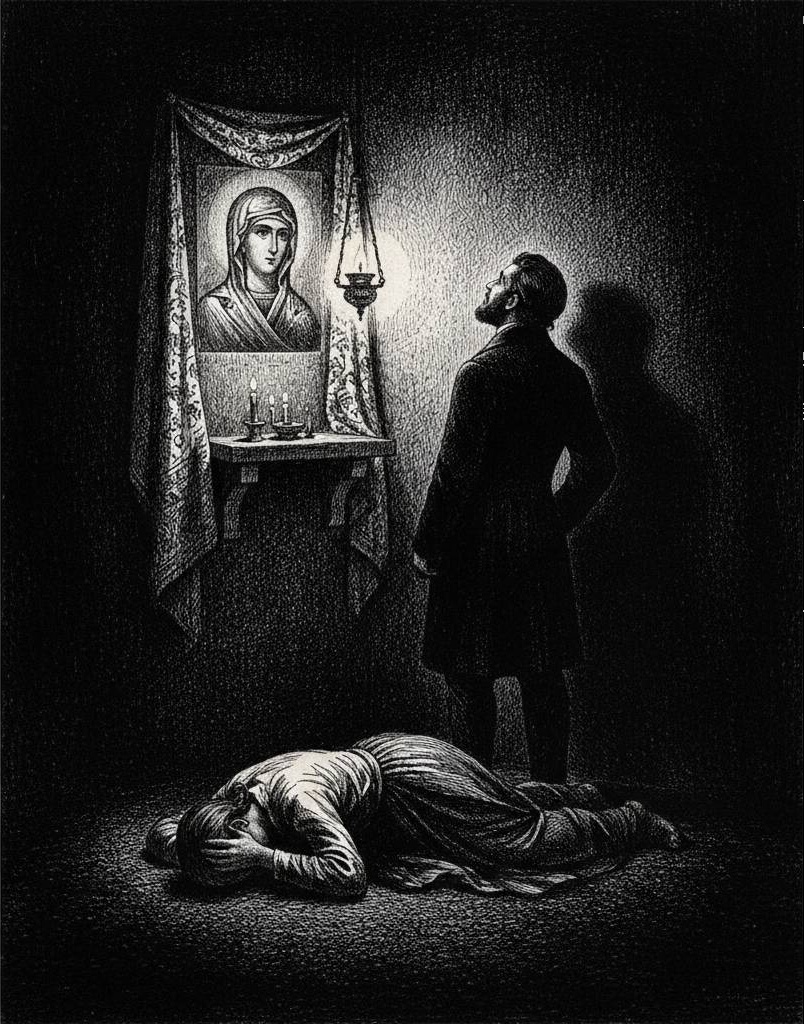
Fyodor, Ivan, and Alyosha drink brandy after the servants leave. Fyodor rants about peasants, Russia, and monasteries — then turns the table into a game show: “Ivan, is there a God?” “No.” “Alyosha?” “Yes.” “Immortality?” Same answers. Three words from Alyosha — “Immortality is in God” — carry more weight than any argument. The conversation spirals through Fyodor’s philosophy of women — his genuine yet predatory eye for beauty — into the story of spitting on Sofia’s icon while she prayed. Alyosha breaks down in the same hysterical fit his mother used to have. Ivan snaps: “his mother was also my mother” — the one time his mask cracks in fury. Dmitri kicks the door down.
What You Need to Know
Chermashnya — a village/small estate belonging to Fyodor, used for timber sales and land deals.
“Credo” — Latin for “I believe.” The opening word of the Nicene Creed, the fundamental statement of Christian faith recited in every Orthodox and Catholic service.
Mephistopheles — the devil in Goethe’s Faust. A sophisticated, witty, charming tempter — not a fire-and-brimstone demon. “Something Mephistophelian” = clever and seductive, not evil.
Hero of Our Time / Arbenin — Two different Lermontov works. Hero of Our Time’s protagonist is Pechorin (a cynical, charming manipulator). Arbenin is from a different play, Masquerade. Fyodor confuses them — he’s drunk.
Piron — Alexis Piron (1689–1773), a French writer famous for devastating one-liners. “There’s something of Piron in him” = he’s got sharp wit.
Feuerbach — Ludwig Feuerbach (1804–1872), German philosopher who argued God is a human invention — we project our best qualities onto an imaginary being. His ideas influenced Marx and the whole atheist intellectual tradition in Europe.
Mount Athos — a peninsula in Greece that’s been an autonomous monastic republic since 972 AD. No women allowed — not even female animals. The spiritual heart of Orthodox monasticism, where the elder tradition was preserved for centuries. “Mount Athos tricks” = old monastic cunning — the shrewdness that comes from centuries of monks navigating politics, money, and power while claiming to be above it all.
“Observing the feasts of Our Lady” — more than fasting. In Orthodoxy, observing a feast means abstaining from meat/dairy, attending special liturgies, intensified prayer and prostrations, and behavioral restraint — no entertainment, full spiritual focus. The person is in a state of heightened spiritual openness, stripped down and vulnerable. Similar to how Ramadan isn’t just not eating — it’s a full spiritual mode shift.
Icons in this context — icons are sacred presences, not decorations. Desecrating one is spiritual violence. Keep that in mind when icons come up here. → Icons
The klikushi response — hysterical fits triggered by spiritual/emotional overwhelm. Can be hereditary. → [[The Brothers Karamazov#the-klikushi-shriekers|The Klikushi (“Shriekers”)]]
Margin Notes
Fyodor the predator — he finds the unique thing in each woman and weaponizes it. Adelaida’s wildness, Sofia’s innocence, old maids’ loneliness. His “appreciation” of women IS the weapon. The icon scene is the purest example: he found Sofia’s faith — the thing that made her HER — and attacked it directly.
Fyodor and Smerdyakov’s shared logic — Fyodor spits on the icon and says “nothing will happen to me.” Smerdyakov says “tell the mountain to move — it won’t.” Both are testing God with the same dare: prove yourself or you’re not real. Father and son, same method. One does it from spite, the other from cold logic.
Highlights
Ivan on truth reigning
“But if that truth were to come to reign, you’d be the first one to be robbed and then … destroyed.”
Ivan’s reply when Fyodor says abolish the monasteries so truth can reign. Even Fyodor admits he’s right.
Civilization and God
“Civilization wouldn’t exist if man hadn’t invented God.”
Ivan echoing Feuerbach — God as humanity’s invention, but a necessary one.
"Your heart is better than your head"
“No, I’m not angry. I know your thoughts. Your heart is better than your head.”
Alyosha to Fyodor. The simplest, truest thing anyone says to him in the whole novel.
Barefoot girlies
“I’ll show you a girlie there; I noticed her a long time ago. She’s still running around barefoot. Don’t be afraid of barefoot girlies; don’t despise them—they’re pearls!”
Fyodor trying to lure Ivan to Chermashnya with a girl. The bait is always a woman.
Russian Marquis de Sades
‘We really like,’ he says, ‘to sentence girls to be whipped, and we let the young lads do the whipping. Afterward, he who whips a girl today, asks her to marry him tomorrow. And this suits the girls, too.’ What Marquis de Sades we have!
Fyodor recounting a Mokroye peasant custom — violence and courtship as the same act.
Fyodor's philosophy of women
“For me… . I never met an ugly woman in my whole life, that’s been my rule! Can you understand that? … According to my rule, you can find something extraordinarily interesting, devil take it, in every woman, that you won’t find in any other. You only have to know how to find it, that’s the rub! It’s a talent!”
Genuine appreciation and predatory instinct fused into one speech. He sees people — and uses what he sees.
The icon scene
I never used to embrace her, but all of a sudden, when the moment came, I would shower her with affection, crawl on my knees, kiss her feet, and always, always—I remember it as if it were today—I would reduce her to that mellow, jingling, nervous special laugh of hers… . I thought, I’ll beat this mysticism out of her! ‘You see,’ I said, ‘you see your icon there, well, I’ll take it down. Just look, you think it’s miraculous, but I will spit on it in front of you, and nothing will happen to me as a result!’ When she saw this, good Lord, I thought she’d kill me right then, but she merely jumped up, wrung her hands, and suddenly covered her face, began trembling all over, and fell down on the floor… . And there she stayed… .
Fyodor’s full confession — the laughing, the icon, the collapse. He says “only once” like it’s nothing.
Dmitri arrives
“He’ll kill me, he’ll kill me! Don’t let him, don’t!”
The chapter’s last line. Fyodor clings to Ivan’s coat as Dmitri kicks the door down.
Ch 9 — “The Sensualists”
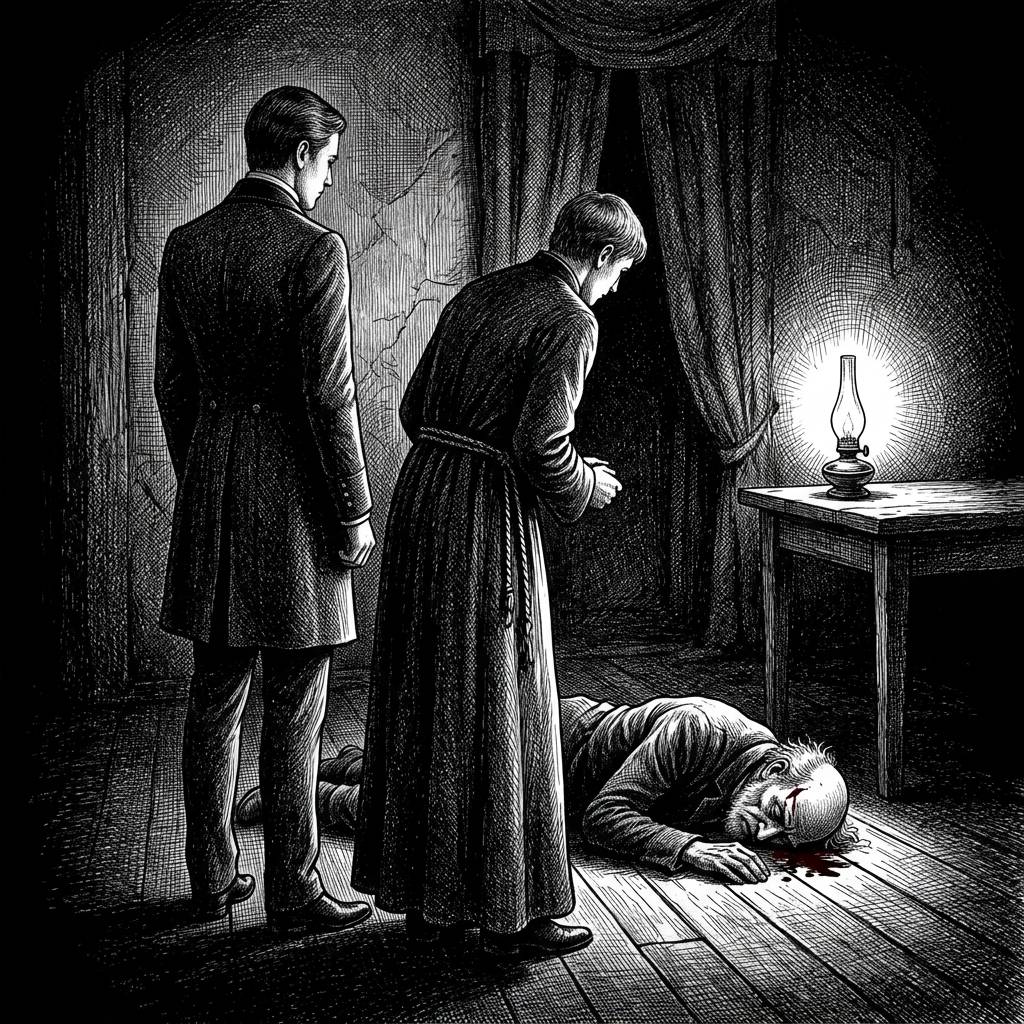
Dmitri storms in looking for Grushenka — he saw her running toward the house. Grigory blocks the inner doors; Dmitri knocks him down and tears through every room. She’s not there. All doors locked, all windows sealed, key in Fyodor’s pocket. Dmitri grabs his father by the last tufts of hair and throws him to the floor, kicks his face. Ivan and Alyosha pull him off. Dmitri leaves with two messages: tell Katerina Ivanovna “he bows farewell,” and don’t mention the money to “Aesop.” After Fyodor is put to bed, Ivan whispers to Alyosha: “One viper devours another; good riddance to both of them.” Fyodor wakes, asks for a mirror, says he fears Ivan more than Dmitri, gives Alyosha the icon of the Mother of God, and begs him to come tomorrow — “don’t say a word to Ivan.” In the courtyard, Ivan and Alyosha have the chapter’s real conversation: does anyone have the right to wish another man dead? Ivan says yes — “who lacks the right to desire?” — and allows himself “complete leeway” in his desires. They shake hands warmly, as never before.
What You Need to Know
“Aesop” — both Dmitri and Ivan call Fyodor this. In 19th-century Russian usage, “Aesop” meant a sly, ugly old man who hides truth inside fables and never speaks directly. From Aesop the Greek fabulist — but the Russian connotation leaned more toward cunning and grotesque. Fits Fyodor perfectly: a man who buries real feelings inside buffoonery.
“Vanechka” / “Lyoshechka” — Fyodor’s panic-mode nicknames for Ivan and Alyosha. These are extra affectionate diminutives (beyond the standard Vanya/Lyosha). A parent using these with adult sons signals either deep tenderness or desperate clinging. Here it’s the second one.
“Bow to you, bow to you, bow to you” — Dmitri’s message to Katerina Ivanovna. A poklon (bow) in Russian culture is both greeting and farewell. Three bows is emphatic. And “bow farewell” — proshchal’ny poklon — is a formal, final goodbye. Dmitri is telling Alyosha to deliver a breakup.
The icon of the Mother of God — when Fyodor offers this to Alyosha, remember: this is the same icon he spat on in front of Sofia (Ch 8). The icon that broke her. Now he’s handing it to the son who inherited her faith. Whether it’s guilt, superstition, or genuine love — Dostoevsky doesn’t say.
Margin Notes
Ivan’s two cracks — the viper line inside the house was hot, impulsive, whispered with “a malicious expression.” The courtyard conversation is the same position — but cold, philosophical, reasoned. He took an ugly impulse and built a framework around it. The second one is more dangerous.
Fyodor’s instincts — Dmitri beat him bloody. Ivan saved him. Fyodor fears Ivan more. He can’t articulate why, but he senses that cold calculation is more lethal than hot rage. He’s reading the room better than anyone.
The icon’s journey — weaponized against Sofia in Ch 8, given to Alyosha in Ch 9. From instrument of cruelty to offering of… something. Guilt? Love? Superstition? All three coexisting — Karamazov duality again.
Highlights
"Serves him right!"
“Serves him right!” Dmitry cried out, gasping for breath. “And if I didn’t kill him, I’ll come again to do so. You won’t manage to save him!”
Dmitri gasping, not remorseful. A promise, not a threat.
"I don't regret shedding your blood"
“I don’t regret shedding your blood!” he cried. “Watch out, old man, watch over your dream, because I have a dream, too! I curse you and renounce you forever …”
His last words before leaving. “Watch over your dream” — they’re both chasing Grushenka. The dream is the same dream.
"I used to wash him in the tub"
“He dared hit me!” Grigory complained glumly and distinctly. “He dared hit even his own father, not only you!” Ivan Fyodorovich replied, with a wry grin. “I used to wash him in the tub … and he hit me!” repeated Grigory.
The old servant who raised Dmitri — reduced to this.
One viper devours another
“Devil take it, if I hadn’t pulled him off, he might have even killed him. It wouldn’t have taken much to do in that Aesop,” Ivan Fyodorovich whispered to Alyosha. “God forbid!” cried Alyosha. “Why ‘God forbid’?” Ivan continued his whispering, with a malicious expression on his face. “One viper devours another; good riddance to both of them!”
Ivan’s mask cracks for the second time. The first was kicking Maksimov off the carriage (Ch 8). This one is worse.
"I'm more afraid of Ivan"
“What does Ivan say? Alyosha, my dear boy, my only son: I’m afraid of Ivan. I’m more afraid of Ivan than the other one. You’re the only one I’m not afraid of.”
Dmitri just beat him. Ivan just saved him. Fyodor fears Ivan more.
The icon returns
“That icon of the Mother of God that I told you about recently, take it for yourself, carry it away. I permit you to return to the monastery… . I was joking before; don’t be angry.”
The same icon he spat on in front of Sofia. Now handed to the son who inherited her faith.
"Don't say a word to Ivan"
“When you do, pretend that you came on your own to visit me. Don’t tell a soul that I asked you to come. Don’t say a word to Ivan.”
Beaten and bleeding, still scheming.
The courtyard — "who lacks the right to desire?"
“Brother, let me ask one more thing: does any man really have the right, regarding other people, to decide which of them is worthy to live and which one is not worthy?”
“Why introduce the question of worth into this matter? This question is decided most of all in men’s hearts, not on the basis of worth, but for different reasons, much more natural ones. And as far as the right is concerned, who lacks the right to desire?”
“Not the death of another man?”
“Yes, perhaps even that. Why lie to oneself, when all men live like that?”
Alyosha circling back to the viper line. Ivan doubling down — calmly, philosophically. The hot impulse becomes a cold position.
"I allow myself complete leeway"
“You should know that I’ll always defend him. But in my desires, I allow myself complete leeway in that case.”
He’ll stop a murder with his hands. He won’t stop one in his heart.
Ch 10 — “Both Together”
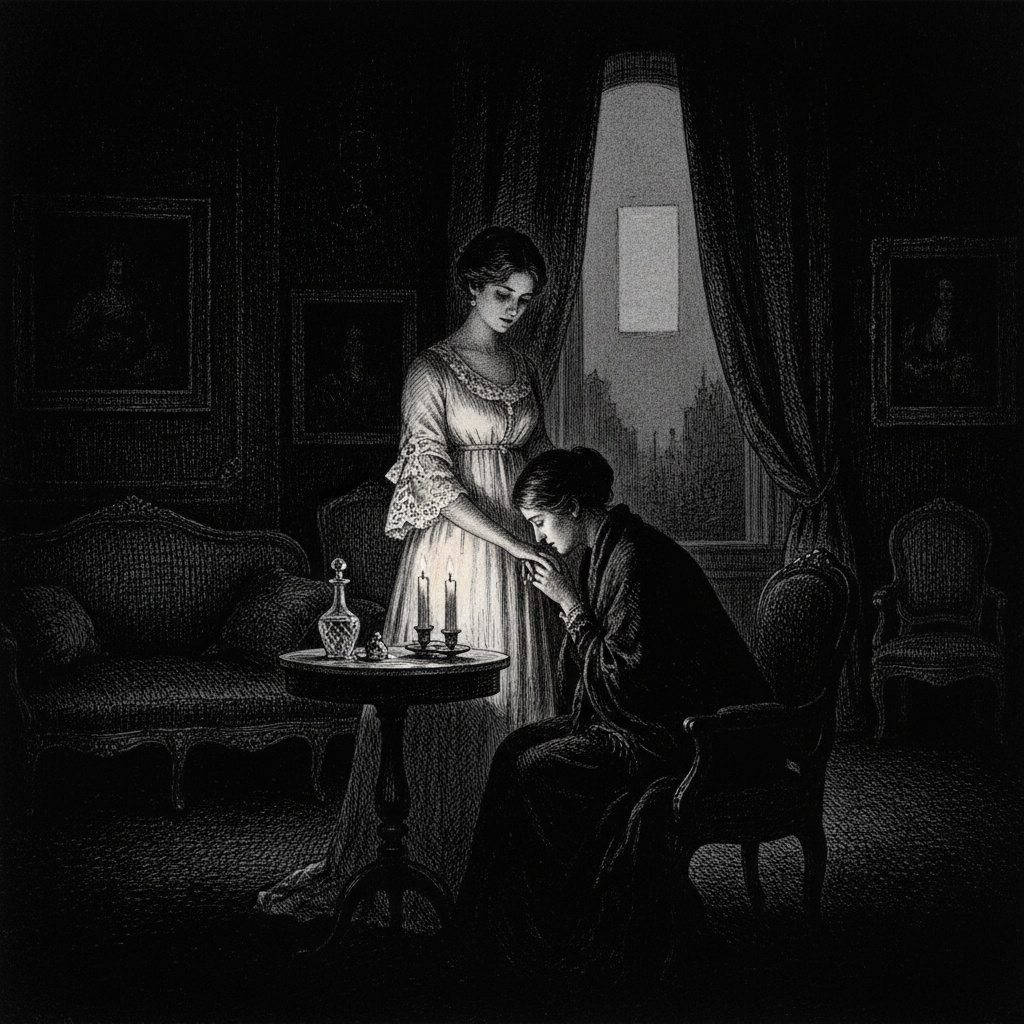
Alyosha arrives at Katerina Ivanovna’s house to deliver Dmitri’s farewell bow. Katerina doesn’t accept the message — she reverse-engineers Dmitri’s psychology from the emphasis alone, concluding he’s in despair, not resolved. She reveals Grushenka is in the next room — her angel, her ally, the solution to everything. Grushenka enters: childlike, soft, sugary. Katerina kisses her hand three times. Grushenka holds Katerina’s hand to her lips… pauses… and refuses to kiss it. “So that you’ll remember.” The room explodes. Grushenka leaves laughing. Katerina collapses — not from the refused kiss, but from learning Dmitri told Grushenka about the night she sold her beauty for her father’s sake.
What You Need to Know
“The institute” — a women’s institute, a finishing school for daughters of military officers and nobility. Strict, regimented, French-speaking. Produced women who were educated, polished, and very conscious of social rank.
“For reasons of etiquette” — a young unmarried woman couldn’t live alone in 1870s Russia without it being scandalous. You needed older female relatives in the house to keep it respectable. The aunts are there to make the household look proper.
Silk mantilla — a Spanish-style lace or silk shawl worn over the head and shoulders. Fashionable among upper-class Russian women who followed Western European trends.
Málaga raisins — raisins imported from Málaga, southern Spain. A luxury item in 1870s Russia — signals wealth and cosmopolitan taste.
Venus de Milo — the famous armless Greek statue of Aphrodite, discovered on the island of Milos in 1820. By Dostoevsky’s time it was the canonical standard of female beauty in European culture. When the narrator invokes it, he’s reaching for the highest possible reference point.
“On a scaffold, by the public executioner” — not metaphorical. Public flogging by an executioner (palach) was a real legal punishment in Russia until the judicial reforms of the 1860s. Even after abolition, the image carried weight — total public humiliation, not just pain.
“Bow farewell” (proshchal’ny poklon) — A formal, final goodbye. Three bows carries Orthodox weight (the Trinity). Dmitri repeated it three times so Alyosha wouldn’t soften the delivery — not a ritual, an insistence.
Margin Notes
Katerina reads the bow — Her first instinct isn’t to hear the farewell — it’s to diagnose Dmitri’s state. She reverse-engineers his psychology from the emphasis: casual = over, emphatic = panic. “He leapt headlong from a mountain.” She’s probably right. But accurate perception becomes delusional conclusion: “he’s in despair” → “I can save him forever.” She rebrands rejection as a rescue mission. The most dangerous self-deception is the kind built on true observations.
Highlights
"You might not be happy with her forever"
“No, you may love her forever, but you might not be happy with her forever …”
Alyosha at twenty, seeing what Dmitri can’t.
"He leapt headlong from a mountain"
“He didn’t leave me with a resolute step; rather, he leapt headlong from a mountain. The emphasis on this word could have been pure bravado.”
Katerina reverse-engineering Dmitri’s psychology from a single word.
"I can save him"
“And if so, then he’s still not lost! He’s merely in despair; but I can save him.”
The leap from accurate observation to delusional mission.
"Let him be ashamed before everyone else, but not before me"
“Let him be ashamed before himself and before everyone else, but not before me.”
She doesn’t want to fix his shame — she wants to be exempt from it. That’s possession, not love.
"It's passion, not love"
“Can a Karamazov really burn with a passion like that forever? It’s passion, not love. He won’t marry her because she won’t have him.”
Katerina diagnosing Dmitri and Grushenka. She might be right about this too.
"The most fantastic of fantastic creations"
“That young woman is an angel, do you know that? Do you? She’s the most fantastic of fantastic creations!”
Katerina calling her rival an angel — seconds before the angel destroys her.
The wild beast is ordinary
“Here she was, this terrible creature—this ‘wild beast,’ as his brother Ivan had called her less than half an hour before. And yet, there she stood before him, seeming to be the most ordinary and simple creature.”
Every label anyone gave Grushenka dissolves on contact.
"Perhaps there's too much ecstasy"
“Perhaps there’s too much ecstasy”—the thought flashed through Alyosha’s mind. He blushed. His heart felt a peculiar discomfort all the time.
Alyosha’s gut sensing the performance before anyone else.
Grushenka's backstory
“There was one man, also an officer; we fell in love with him, and sacrificed everything for him; this was a long time ago, five or six years ago, but he forgot us and got married. Now he’s become a widower; he wrote that he’s coming here—and you should know that we love only him, him alone.”
The first time we learn who Grushenka actually is under the “wild beast” label. Five years of waiting for one man.
"I have a wicked heart"
“I have a wicked heart; I’m willful. I made Dmitry Fyodorovich, poor fellow, a captive, only to have some fun.”
Grushenka told Katerina the truth. Katerina chose not to hear it.
The refused kiss
“Do you know what, my angelic young lady,” she drawled abruptly in the most tender and sugary little voice, “do you know what, perhaps I won’t kiss your hand after all.”
Two or three moments of silence. Then the cruelest line in Part 1.
"You kissed my hand, but I didn't kiss yours"
“So that you’ll remember that you kissed my hand, but I didn’t kiss yours.”
The power reversal in one sentence.
"He told that creature"
“He did it! How could he be so dishonorable, so inhuman? Why, he told that creature what happened then, on that fateful, accursed day! ‘You went to sell your beauty, dear young lady.’ She knows!”
The real wound. Not the refused kiss — the exposed secret.
"Don't condemn me"
“Leave, Aleksey Fyodorovich! I’m ashamed, I feel awful! Tomorrow … I beg you on my knees, come again tomorrow. Don’t condemn me; forgive me; I don’t know what I’ll do with myself now!”
Katerina stripped of every performance. The only genuine words she speaks all chapter.
"I arranged this whole scene for your benefit"
“Dearest Alyoshenka, see me off, will you? I’ll tell you a little something along the way! I arranged this whole scene for your benefit, Alyoshenka.”
Grushenka’s exit line. The cruelty was a performance — for Alyosha. Why?
Ch 11 — “One More Reputation Ruined”
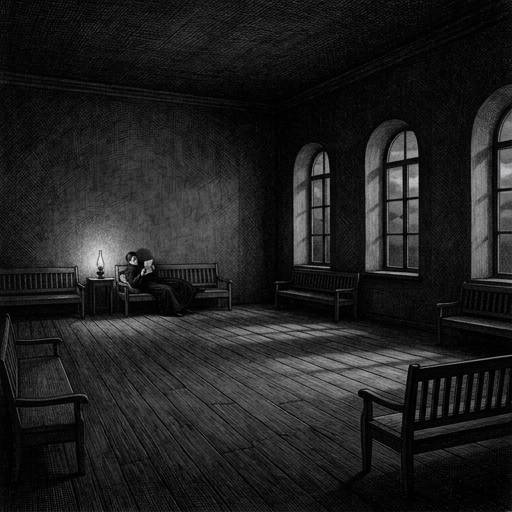
Alyosha walks back to the monastery at night — dark road, clouds, wind. At the crossroads, Dmitri ambushes him from under a willow tree with “your money or your life!” — a joke that was almost not a joke. He’d been inventorying his hanging materials moments before Alyosha appeared. Alyosha recounts the Grushenka scene; Dmitri erupts into delighted laughter, calls Grushenka “the queen of all infernal women,” diagnoses Katerina with total clarity, then accepts his own verdict: “I’m a scoundrel.” Before leaving he strikes his chest — something physical is there, a disgrace worse than anything he’s done, and he won’t stop it. Back at the monastery, Zosima is dying. Alyosha kneels before his sleeping elder, then retires to the reception room. In his pocket — a pink envelope from Lise, a love letter. He reads it twice, chuckles softly, prays for everyone he met that day, and falls into peaceful sleep.
What You Need to Know
“Revelation of thoughts” (otkrovenie pomyslov) — a monastic practice going back to the Desert Fathers (4th–5th century Egypt/Syria). Monks reveal every thought — sins, temptations, distractions, even dreams — aloud in the elder’s cell, with other monks present. Not the same as sacramental confession (ispoved’), which is private, one-on-one with a priest, and sealed. Revelation of thoughts is a spiritual discipline, not a sacrament — no seal, no formal absolution. It traveled from the desert to Byzantine monasteries, to Mount Athos, and into Russia via the same revival that brought the elder tradition back → Ch 5. The controversy was real at Optina Pustyn in Dostoevsky’s time: critics said it looked too much like confession and gave elders unchecked power over monks, bypassing the abbot’s authority. Defenders said it predated the sacrament and was a completely different thing.
Margin Notes
The willow tree — Dmitri was planning to hang himself before Alyosha arrived. Kerchief, shirt, suspenders — he inventoried the materials. Then Alyosha appeared and the suicidal impulse instantly flipped into “your money or your life!” as a joke. The distance between “I’ll end it here” and “I’ll amuse him, I’ll scare him” is about three seconds. Love literally interrupted death. The Karamazov emotional range at full throttle — the darkest impulse and the warmest love in the same breath, and both completely genuine.
“One More Reputation Ruined” — the title isn’t about Dmitri, Katerina, or Grushenka. It’s Lise. After ten chapters of violence, betrayal, and spiritual crisis, Dostoevsky names his Part 1 finale after a fourteen-year-old girl writing her first love letter: “Now the secret of my reputation, perhaps ruined forever, is in your hands.” The smallest possible stakes, placed right next to the largest. Dostoevsky respects her scale as much as anyone else’s.
Highlights
The willow tree
“Here’s a willow, I have a kerchief, a shirt; I can twist it into a rope in a minute; in addition, I have suspenders, and—I won’t burden the earth anymore, won’t dishonor it with my vile presence! And then I heard you coming—good Lord, it was as if all of a sudden something descended on me: so there’s one man whom even I love.”
Suicidal planning to brotherly love in three seconds flat.
Dmitri hears about the refused kiss
“So she wouldn’t kiss her hand! So she didn’t kiss it and ran away!” he cried in some sort of morbid ecstasy—one could even say brazen-faced ecstasy, if this emotion hadn’t been so unaffected.
His fiancée just got publicly destroyed and his reaction is pure delight. Menacing stillness cracking into uncontrollable laughter.
"I see right through her"
“It’s the very same little Katenka, the boarding-school girl who wasn’t afraid to come running to a ridiculous rude officer out of a generous desire to save her father, risking major insult! But our pride, our need to take risks, our defiance of fate, our infinite audacity!”
Dmitri diagnosing Katerina with total clarity — and total tenderness.
"It's a dagger into the heart"
“She was crying then, but now… . Now ‘it’s a dagger into the heart!’ That’s the way it is with women.”
Not dismissive — mourning. Something tender from Mokroye became a weapon.
"I'm a scoundrel"
“Yes, I’m a scoundrel! Undoubtedly a scoundrel. It doesn’t matter whether I cried or not, I’m still a scoundrel! Tell her that I accept the designation, if that will console her.”
Full acceptance, no excuses. Then immediately walks away.
The disgrace on his chest
“Look at me, look closely; you see, here, right here—there’s a terrible disgrace being prepared.” (In saying “right here,” Dmitry struck his chest with his fist with such a strange expression, as if the disgrace lay there in his chest, in some place, a pocket, perhaps, or something sewn around his neck.)
Something physical on his body. The narrator draws your eye to it. Worse than anything he’s done before — and he won’t stop it.
Monks gaming the system
“They even pointed out to the church authorities that such confessions didn’t achieve their worthy goals, but in fact led deliberately to sin and temptation.”
The controversy over revelation of thoughts — a system designed to destroy performance creating new performances.
Letters screened by the elder
“He also knew that there were some among the brothers who resented the fact that it was customary to submit letters they received from their relatives to the elder to be read before they got to see them.”
Total submission means total access — even your mail.
Alyosha chooses the monastery
“His heart was burning with love, and he bitterly reproached himself that in town, at a moment like this, he had even forgotten about the person he’d left on his deathbed in the monastery, someone he revered more than anyone on earth.”
Guilt and love pulling him back. He decides to stay — breaking every promise he made in town.
Lise's letter
“Paper, they say, will not blush; but I can assure you this isn’t true, and that it’s blushing now, just the way I am. Dear Alyosha, I love you; I have loved you since childhood, since Moscow, when you were not at all like the way you are now, and I’ll love you all my life.”
The most human moment in Part 1. After ten chapters of vipers and icons and fury — a teenage girl’s love letter.
Alyosha's prayer
“Lord, have mercy on all of them; keep all these unhappy and troubled souls I met today in Your charge, and guide them. All ways are Thine: save them by Thy wisdom. Thou art love; Thou will send them all joy!”
After the worst day imaginable — he prays for everyone’s joy and falls into peaceful sleep. The realist from Ch 5.